React Native Development Services For iOS and android
Our React Native development services help businesses build stunning, high-performance mobile apps that work seamlessly on both iOS and Android. Instead of developing two separate applications, we leverage React Native’s single codebase to create efficient, cost-effective, and powerful solutions.
Why Choose React Native?
React Native is an open-source framework created by Facebook, a global tech leader. Furthermore, It uses the popular JavaScript library React, which web developers already know, to build truly native mobile applications. Moreover, this means the user interfaces are rendered using platform-specific components, delivering a user experience that’s virtually indistinguishable from an app built with native languages like Swift or Kotlin.
Our React Native Services
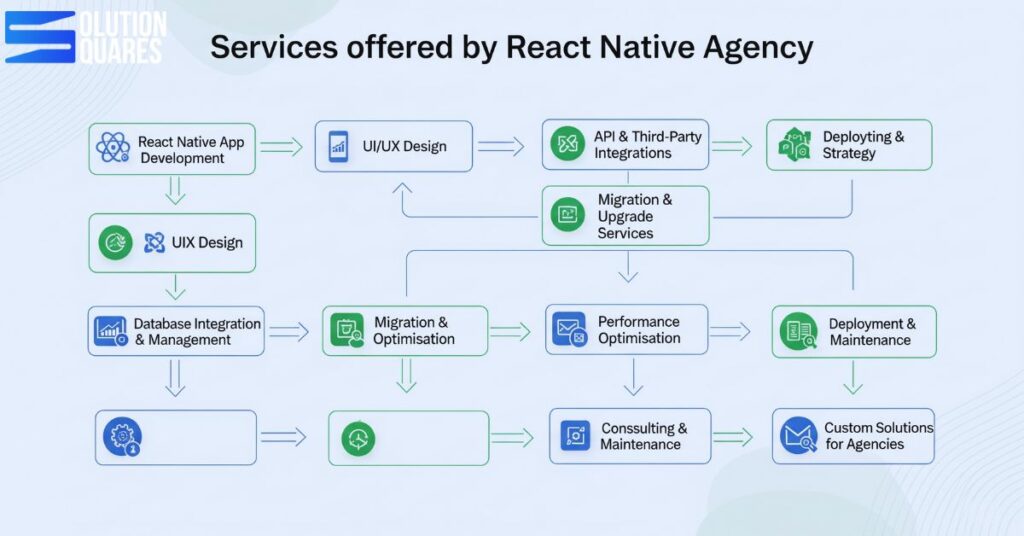
We offer a comprehensive suite of services to meet your specific needs:
Custom App Development: We create tailor-made mobile applications from scratch, focusing on your unique business requirements and user goals.
API Integration: We seamlessly integrate your app with third-party services and APIs to enhance functionality.
UI/UX Design: Our design team crafts intuitive, beautiful interfaces that ensure a smooth and engaging user experience.
Maintenance & Support: We provide ongoing support, updates, and maintenance to keep your app running smoothly and securely.
Migration Services: We help you migrate existing applications to the React Native framework, modernizing your app and improving its performance.
Indeed, We combine deep technical expertise with a collaborative approach to ensure your project is delivered on time and within budget. Whether you’re a startup looking to launch your first app or an established enterprise aiming to improve your mobile presence, our team is ready to help you achieve your goals. .
React Native combined with GraphQL offers an efficient and scalable solution for mobile app data management.
Apollo Client streamlines state management by automating data caching and updates, reducing development time and bugs.
Proper setup of the development environment is essential for successful integration of GraphQL with React Native.
Advanced query handling techniques, such as pagination and caching strategies, enhance app performance and scalability.
Utilizing reliable resources and tutorials can significantly aid in mastering the integration process.
React Native with GraphQL: A Comprehensive Integration Guide
Introduction
React Native shines as a powerful cross-platform mobile development framework, while GraphQL stands out as a modern data query language for APIs. When combined, React Native with GraphQL creates a synergy that leads to efficient, flexible, and scalable data fetching for mobile apps. This integration not only empowers developers with powerful UI construction but also offers flexible data access, essential for modern mobile application frameworks.
This tutorial’s objective is to teach you how to integrate GraphQL into a React Native application using Apollo Client. We’ll cover everything from setup and query handling to best practices. By the end, you’ll be proficient in fetching, displaying, and managing remote data using Apollo Client with GraphQL. For a foundational understanding of mobile app development.
Benefits of Integrating GraphQL with React Native
Enhanced Data Fetching Efficiency
GraphQL’s data fetching efficiency is revolutionary, allowing developers to make precise data requests, avoiding unnecessary payloads and reducing overhead and bandwidth usage. This efficiency is crucial in mobile environments where performance and data usage are critical considerations).
Improved Performance and Reduced Over-Fetching
One of GraphQL’s strengths is providing exactly what a component needs, and nothing more. This reduction in over-fetching significantly decreases the app’s load times, enhancing overall performance and user experience.
Simplified State Management with Apollo Client
Apollo Client simplifies state management in React Native applications by automating data caching and updates. This minimizes the manual code required to keep the app’s state in sync with remote data, reducing bugs and speeding up development (Djamware Tutorial).
Setting Up the Development Environment
Prerequisites
Ensure you have the essential tools installed:
Node.js
npm or yarn
React Native CLI
Follow these steps to initialize a new React Native project using TypeScript for type safety, as suggested in Paulo Cappa’s guide:
npx react-native init MyGraphQLApp --template react-native-template-typescript
cd MyGraphQLApp
Choosing a GraphQL API
You can set up a local GraphQL server or use a public GraphQL API for demonstration, such as the SpaceX API or Apollo’s demo server (Pusher Tutorial).
Introduction to Apollo Client for React Native
Apollo Client is renowned for its robust handling of data fetching, caching, and UI updates in JavaScript platforms, including React Native. It enables declarative data fetching and provides powerful tools to manage data efficiently.
Installing Apollo Client in a React Native Project
To add Apollo Client and GraphQL to your project, run:
npm install @apollo/client graphql
# Or with yarn
yarn add @apollo/client graphql
If necessary, include polyfills like whatwg-fetch for older Android support as described in Djamware’s tutorial.
Configuring Apollo Client
Set up the initial configuration for the Apollo Client in a new file (src/apollo/client.js):
import { ApolloClient, InMemoryCache, HttpLink } from '@apollo/client';

const client = new ApolloClient({
  link: new HttpLink({ uri: 'https://your-graphql-api.com/graphql' }),
  cache: new InMemoryCache(),
});

export default client;
Substitute 'https://your-graphql-api.com/graphql' with your specific GraphQL endpoint.
Configuring GraphQL Integration with React Native
Setting Up ApolloProvider
To connect Apollo Client to React Native, wrap your application’s root component with ApolloProvider:
import { ApolloProvider } from '@apollo/client';
import client from './src/apollo/client';

export default function App() {
  return (
    <ApolloProvider client={client}>
      <MainScreen />
    </ApolloProvider>
  );
}
This setup enables any component within your app to access the GraphQL API through Apollo Client.
Handling Queries with Apollo Client in React Native
Introduction to useQuery Hook
The useQuery hook is the fundamental tool for executing queries in functional React Native components. This hook automates fetching, caching, and states updating when performing GraphQL operations.
Example Query Execution
Define and execute a query within a React Native component:
import { useQuery, gql } from '@apollo/client';

const GET_ITEMS = gql`
  query {
    items {
      id
      name
    }
  }
`;

function ItemsList() {
  const { loading, error, data } = useQuery(GET_ITEMS);

  if (loading) return <Text>Loading...</Text>;
  if (error) return <Text>Error: {error.message}</Text>;

  return (
    <FlatList
      data={data.items}
      keyExtractor={(item) => item.id}
      renderItem={({ item }) => <Text>{item.name}</Text>}
    />
  );
}
This component manages its loading and error states and renders the fetched data reactively.
Advanced Query Handling Techniques
Pagination and Infinite Scrolling
Implement pagination using Apollo Client’s query variables, and manage updates to handle paginated data efficiently. This approach helps in maintaining performance even with large datasets (Hasura Tutorial).
Performance Optimization
Avoid unnecessary re-fetches and use GraphQL fragments to minimize the data fetched in each query, as detailed in Djamware’s tutorial. These strategies keep your app responsive and efficient.
Caching Strategies
Leverage Apollo Client’s advanced caching mechanisms to ensure that your app can handle state changes and data updates seamlessly, promising a reliable and swift user experience.
Conclusion
Integrating React Native with GraphQL using Apollo Client can significantly enhance data flow, developer experience, and application performance. This combination offers a robust solution for building modern, scalable, and efficient mobile apps.
Encourage further exploration and continued learning in GraphQL to adapt these practices for your development requirements better.
Frequently Asked Questions
1. How do I integrate GraphQL into my React Native application?
To integrate GraphQL with React Native, use Apollo Client by installing the necessary packages, configuring the client with your GraphQL endpoint, and wrapping your app with the ApolloProvider. Then, utilize hooks like useQuery to fetch and manage data within your components.
2. What are the benefits of using Apollo Client with React Native?
Apollo Client simplifies state management by handling caching and updates automatically, reduces boilerplate code, and provides powerful tools for managing data fetching, which enhances developer productivity and application performance.
3. Can I use a public GraphQL API for testing with React Native?
Yes, you can use public GraphQL APIs such as the SpaceX API or Apollo’s demo server for testing and demonstration purposes.
4. What should I do if my React Native app needs to support older Android versions?
If your app needs to support older Android versions, consider including polyfills like whatwg-fetch as described in various tutorials to ensure compatibility.
5. How can I optimize the performance of my GraphQL queries in React Native?
Optimize performance by implementing pagination, avoiding over-fetching with precise queries, using GraphQL fragments, and leveraging Apollo Client’s caching strategies to minimize unnecessary network requests.
Cross-Platform Efficiency: React Native allows for code reuse across iOS and Android, reducing development time and costs.
Scalability and Performance: AI functionalities can be seamlessly integrated, ensuring scalable and high-performing applications.
Diverse Use Cases: Sectors like e-commerce and healthcare benefit significantly from AI-powered React Native apps.
AI-Powered Mobile Apps with React Native: Revolutionising User Experiences
The digital world is witnessing an explosive growth in AI-powered mobile apps, a trend that’s dramatically transforming user interactions across every touchpoint. With React Native, a framework developed by Meta, at the forefront, developers are now able to blend advanced AI capabilities with top-tier app development to create intuitive and intelligent applications. This blog post examines how the integration of AI with React Native is transforming mobile app experiences, providing advanced features such as chatbots, predictive analytics, and personalised content delivery that cater exceptionally well to user needs. Find out more about how AI is enhancing mobile apps here.
Growth of AI
The popularity of Artificial Intelligence (AI) in mobile apps has skyrocketed in recent years. In 2024 alone:
Generative AI apps—including AI chatbots and AI art generators—earned nearly $1.3 billion in global in-app purchase (IAP) revenue, marking a staggering 180% year-over-year increase on iOS and Google Play platforms Sensor Tower.
Total downloads of these generative AI apps approached 1.5 billion—a near 92% increase YoYSensor Tower.
Across all apps that mention “AI” in their name, subtitle, or description, there were 17 billion downloads in 2024, accounting for roughly 13% of all app downloads worldwide, according toSensor Tower.
Other insights into the growing AI app market include:
Global AI app revenue is projected to reach $3.3 billion for all of 2024, up 51% YoY, based on Sensor Tower’s early estimate of $2 billion in the first eight months, Sensor TowerBusiness Standard.
Consumer spending on AI apps—via in-app purchases—surpassed $1.4 billion in 2024, according to analytics firm Appfigures. That represents a 274% increase compared to 2023’s $380 million TAdviser.
In just 2024, people spent approximately 7.7 billion hours interacting with AI apps—an extraordinary 347% increase over the previous year. Start.ioTechCrunch.
These numbers show that AI isn’t just a trend—it’s now a mainstream, consumer-driven force in mobile apps.
Why React Native + AI Is a Game-Changer?
Given these exploding AI trends, React Native becomes particularly compelling for developers aiming to harness AI on mobile:
Cross-Platform Efficiency Build once—deploy AI-powered features across both iOS and Android with a single codebase.
Integration with Leading AI APIs Seamlessly integrate powerful AI services like OpenAI, TensorFlow.js, ML Kit, Google Gemini, and more.
Rapid Feature Delivery & Scalability With React Native’s fast development tools and architecture improvements (like Fabric and TurboModules), you can prototype and ship AI features—like chatbots, image recognition, or voice assistants—quickly and efficiently.
User Engagement & Personalisation Leverage React Native to deliver experiences that millions of users now expect—from intelligent recommendations to natural conversations, all backed by AI.
Future-Ready App Development React Native’s flexibility lets you add advanced AI enhancements over time—whether it’s AR, voice commerce, or predictive personalization—without rewriting your entire app.
Understanding AI-Powered Mobile Applications
AI-powered mobile apps are far more than just mobile applications. They’re intelligent systems that enhance app functionality and user interaction through machine learning and data analytics. From image recognition systems that categorise and analyse photos to natural language processing (NLP) which powers chatbots and virtual assistants, AI is setting a new standard in how we interact with our devices.
Benefits of AI-Powered Mobile Apps with React Native
Combining Artificial Intelligence (AI) with React Native is reshaping mobile app development. Businesses can now deliver personalised, intelligent, and scalable apps across iOS and Android using a single codebase.
1. Cross-Platform Cost Efficiency
Build once and deploy on both iOS and Android.
AI features like chatbots, recommendations, and image recognition can be integrated seamlessly without duplicating work.
Saves 30–40% in development and maintenance costs compared to native apps.
2. Personalised User Experience
AI tailors app content, product suggestions, and notifications based on user behaviour.
Enhances engagement, loyalty, and conversions.
3. Faster Time-to-Market
React Native’s hot reload and pre-built AI libraries speed up development.
Businesses can launch MVPs quickly and add advanced features later.
4. Improved Performance with New Architecture
React Native’s Fabric Renderer and TurboModules ensure AI-powered apps run smoothly.
Handles heavy tasks like AR, image recognition, or predictive analytics without lag.
5. Future-Ready Scalability
Easily integrates emerging technologies: AR/VR, voice assistants, and IoT.
Apps can grow with user demand without expensive re-engineering.
6. Increased Revenue Potential
AI-driven personalisation increases purchase intent in e-commerce apps.
Smarter user interactions boost conversion rates and app monetisation.
Capabilities of AI-Powered Mobile Apps with React Native
Smart Recommendations
Suggests products, music, or videos based on user behaviour.
Natural Language Processing (NLP)
Powers chatbots and virtual assistants for 24/7 support.
Computer Vision
Enables visual search, barcode scanning, and AR try-ons in fashion, retail, and furniture apps.
Voice Recognition
Hands-free navigation, search, and transactions using voice commands.
Predictive Analytics
Forecasts user needs, sales trends, and customer churn.
Fraud Detection & Security
AI detects suspicious patterns in logins or payments.
Supports biometric authentication like Face ID and fingerprints.
Sentiment Analysis
Identifies customer mood from messages or reviews to improve service.
Content Automation
Generates personalised news feeds, marketing messages, or notifications.
AI-powered mobile apps built with React Native offer businesses a future-ready, cost-effective, and scalable solution. They bring together the strengths of cross-platform efficiency and intelligent AI capabilities to deliver mobile apps that are smarter, faster, and more engaging.
Integrating AI into React Native Apps
Integrating AI into React Native apps involves identifying the AI features that will enhance the app, selecting suitable APIs or libraries, and effectively implementing these functionalities.
Key Steps for AI Integration:
Determine AI Needs: Understand what AI functionalities will enhance your app.
Select the Right Tools: Decide on suitable AI APIs or libraries like TensorFlow Lite or IBM Watson.
Implementation: Seamlessly integrate these AI functionalities into the React Native app. Learn how
Popular tools and APIs include TensorFlow Lite, Dialogflow, and OpenAI’s ChatGPT, which enrich React Native apps with cutting-edge AI capabilities. More on popular AI libraries can be found.
Use Cases of AI-Powered Mobile Apps Built with React Native
React Native provides the cross-platform foundation, and AI adds intelligence and personalisation. Together, they can power a wide range of mobile applications across industries.
1. E-commerce & Retail Apps
AI-driven product recommendations.Visual search (upload a photo to find similar items).
Dynamic pricing and personalised discounts.
AR-based try-on for fashion, furniture, and accessories.
Example: An app like Myntra or Amazon with AI-powered personalisation.
2. Healthcare & Fitness Apps
AI symptom checkers for self-diagnosis.
Fitness trackers that adapt workouts using predictive analytics.
Mental health chatbots for 24/7 support.
Medical image recognition for scan analysis.
Example: A personal fitness coach app with AI-powered health insights.
3. FinTech & Banking Apps
Fraud detection for secure transactions.
AI-powered personal finance managers and budgeting apps.
Robo-advisors for investment planning.
Voice-enabled banking assistants.
Example: An app like Mint or Robinhood with AI finance recommendations.
4. Education & E-Learning Apps
Adaptive learning platforms that adjust lessons based on student performance.
AI tutors and chatbots for instant help.
Speech recognition for language learning.
Smart quizzes and progress predictions.
Example: A Duolingo-style app enhanced with AI tutors.
5. Travel & Hospitality Apps
AI chatbots for hotel and flight booking.
Smart itinerary planning based on preferences.
Real-time translation for global travellers.
Predictive pricing for tickets and accommodations.
Example: A trip-planning app like Hopper with AI price forecasts.
Cross-platform Development: React Native allows for a single codebase across iOS and Android, reducing both development time and costs.
Superior Performance: Delivers native-like performance, ensuring fast browsing speeds and high conversion rates.
Scalability and Maintainability: Its modular architecture and strong community support make scaling and maintaining e-commerce apps efficient and cost-effective.
Rich Feature Set: Offers essential features like reusable components, hot reloading, and seamless integration with native modules.
Future-Proof: Adapts to emerging technologies and evolving consumer behaviours, ensuring long-term relevance.
Why React Native is the Best Choice for E-commerce Apps in 2025
The digital marketplace is booming, thanks especially to the accelerated growth of mobile commerce. As consumers increasingly turn to their smartphones for shopping, businesses are faced with a pivotal decision: choosing the right technology stack to drive success. React Native for E-commerce Apps emerges as a frontrunner in this arena. Codilar reports significant growth in mobile shopping, underlining the importance of responsive and efficient mobile applications. Furthermore, the choice of technology impacts crucial development aspects including speed, cost, scalability, and overall user experience, making the selection ever more critical (3Brain Technolabs).
Why Choose React Native for E-commerce Applications Native has gained recognition for its efficiency and adaptability in the mobile app development arena, making it especially suited for e-commerce applications
1. Cross-Platform Efficiency
React Native allows you to build apps for iOS and Android from a single codebase, which means:
Faster development timelines.
Reduced cost of maintaining two separate apps.
Consistent user experience across devices.
2. High Performance for E-commerce Needs
React Native’s new architecture (Fabric & TurboModules) in 2025 ensures smoother animations and faster rendering.
Supports large product catalogues, quick filtering, and seamless checkout without lag.
Integration with native modules helps in performance-heavy tasks like AR product previews and payment gateways.
3. Rich UI & UX for Online Shopping
E-commerce success depends on great design and usability. React Native offers:
AR/VR support for virtual try-ons in fashion or furniture apps.
Voice commerce features via integration with Alexa and Google Assistant.
8. Strong Community & Support
Backed by Meta and the open-source community.
Regular updates, bug fixes, and security patches.
Huge ecosystem of plugins for e-commerce development.
React Native remains the top choice for e-commerce apps in 2025 because it blends speed, cost-effectiveness, and performance with cutting-edge features like AI, AR, and seamless cross-platform development. It’s a future-ready solution for businesses aiming to deliver a smooth, engaging, and scalable shopping experience.
React Native Advantages
As a leading framework used by developers across the globe, React Native facilitates the creation of seamless, robust mobile commerce platforms.
Cross-platform Capabilities
One of React Native’s most compelling features is its ability to let developers use a single codebase to launch apps across multiple platforms (iOS and Android). This cross-platform capability conserves resources and slashes development costs, making it ideal for startups and companies with constrained budgets.
Performance Benefits
Next, the framework’s ability to deliver native-like performance is crucial for maintaining fast browsing speeds and securing high conversion rates – key for any e-commerce business.
Faster Time-to-Market
React Native comes packed with features like hot reloading and access to a vast library ecosystem, which streamlines the development process. These features enable quicker iterations and updates, significantly speeding up time-to-market.
Reusable Components
By using reusable components Solutions Squares, developers can ensure a consistent UI/UX across different platforms, which is essential for maintaining brand identity and user satisfaction. This includes modular elements like product cards and cart buttons.
Hot Reloading
The hot reloading feature in React Native enhances developer productivity by reflecting code changes instantly, thereby speeding up debugging and feature enhancement timelines. (React Native Expert)
Integration with Native Modules
React Native eases integration with native modules, thereby enriching the app with advanced functionalities such as secure payment processing and tailored user experiences. (React Native Expert, 3Brain Technolabs)
Smooth Animations and Transitions
Engaging animations and seamless transitions are crucial for user retention. React Native makes implementing these smooth, eye-catching animations straightforward, thus enhancing user engagement. (React Native Expert)
Customised User Interfaces
Brand identity can be strongly conveyed through customised user interfaces, which are easily achievable with React Native. Tailoring the app’s aesthetics to match the company’s theme strengthens brand recognition. (Codilar)
Responsive Design
React Native’s responsive design capabilities ensure that e-commerce apps provide optimal usability across all device sizes, from smartphones to tablets. (React Native Expert, 3Brain Technolabs)
Modular Architecture
The framework’s modular architecture simplifies the process of updating existing features and integrating new ones, thereby supporting scalable app solutions. (3Brain Technolabs, Lucenta Solutions)
Community Support and Ecosystem
A robust, active global community Solutions Squares of developers means that support and resources are readily available, facilitating easier enhancements and troubleshooting. (3Brain Technolabs, PagePro)
Lower Maintenance Costs
With a single code base to manage across multiple platforms, maintenance overheads are significantly reduced, lowering long-term operational costs.
The scalability and maintainability advantages provided by React Native ensure that e-commerce platforms can evolve with growing business demands efficiently and cost-effectively.
Case Studies: Successful E-commerce Apps Using React Native
React Native has become a go-to framework for building high-performance e-commerce apps. Its ability to deliver a native-like experience with a single codebase has attracted global brands. Below are some case studies highlighting successful e-commerce apps powered by React Native.
1. Walmart
Challenge: Walmart wanted to improve its mobile app performance while reducing development costs for both iOS and Android.
Solution: Switched to React Native for cross-platform development.
Outcome:
95% of the codebase is shared across platforms.
Faster time-to-market with consistent UI.
Significant improvement in performance and user engagement.
2. Shopify
Challenge: Shopify needed a solution for merchants to manage their online stores seamlessly on mobile.
Solution: Adopted React Native to unify Android and iOS apps.
Outcome:
Enabled real-time store management (inventory, orders, payments).
Reduced development effort and maintenance costs.
Scalable app that supports thousands of merchants globally.
3. Amazon (Prime Now)
Challenge: Amazon wanted a fast, lightweight app for its Prime Now delivery service.
Solution: Built the app using React Native for speed and performance.
Outcome:
Delivered real-time updates for grocery and essentials delivery.
Smooth navigation and checkout experience.
Successfully scaled across multiple global markets.
4. Nike
Challenge: Nike needed a platform to engage customers with personalized shopping experiences.
Solution: Integrated React Native to power parts of its mobile commerce experience.
Outcome:
Improved app performance with a modern UI.
Seamless checkout and in-app marketing campaigns.
Boosted conversions and customer loyalty.
5. Myntra (India’s Fashion E-commerce Giant)
Challenge: Myntra wanted a feature-rich app with smooth performance during high-traffic sales.
Solution: Adopted React Native for key features and cross-platform optimisation.
Outcome:
Faster app updates during “Big Sale” events.
Enhanced browsing, filtering, and cart management.
Improved scalability and user retention.
These case studies show that React Native is not just a trend but a proven framework powering some of the world’s most successful e-commerce apps in 2025.
Cost-Effectiveness of Developing E-commerce Apps with React Native
Building an e-commerce app requires balancing performance, speed, and cost. React Native has emerged as one of the most cost-effective solutions for businesses in 2025.
1. Single Codebase for Two Platforms
Traditional development requires separate iOS and Android teams.
With React Native, a single codebase runs on both platforms.
This reduces development costs by 30–40% compared to native app development.
2. Reduced Development Time
Features like Hot Reloading and ready-to-use libraries accelerate development.
Faster time-to-market means businesses start generating revenue sooner.
Perfect for startups or businesses aiming for a quick MVP launch.
3. Lower Maintenance & Updates Costs
Instead of maintaining two apps, you only manage one codebase.
Updates, bug fixes, and feature rollouts become cheaper and quicker.
Saves long-term operational expenses.
4. Pre-Built E-commerce Integrations
Easy integration with payment gateways, product catalogues, push notifications, and APIs.
Reduces the need for expensive custom coding.
Many third-party plugins are open-source, cutting down costs further.
5. Scalability Without Extra Cost
React Native supports high-traffic apps without requiring separate rebuilding.
Businesses can scale features (chatbots, AR product views, AI recommendations) without rewriting the entire app.
This avoids costly redevelopment.
6. Smaller Development Teams
A React Native project typically needs one unified team instead of two.
Saves on hiring, salaries, and management overhead.
Especially beneficial for SMEs and startups with limited budgets.
7. Cloud & Testing Cost Savings
Works seamlessly with emulators, simulators, and cloud-based testing.
Cuts costs for physical device testing.
Faster QA cycles reduce total project expenditure.
React Native is highly cost-effective for e-commerce apps because it:
Cuts down on development and maintenance costs.
Shortens time-to-market.
Requires smaller teams and fewer resources.
Supports future scalability without heavy reinvestment.
For businesses in 2025, React Native offers the best balance of affordability, performance, and long-term ROI for e-commerce app development.
Features for a React Native E-commerce App
User Features
Onboarding & Authentication
Easy sign-up/login (Email, Phone, Social logins).
OTP and biometric authentication (Face ID, Fingerprint).
Product Browsing & Search
Smart search with filters (category, price, rating, brand).
Voice search and AI-powered recommendations.
Barcode/QR code scanner for quick product lookup.
Product Pages
High-quality images with zoom & 360° view.
Product details, specifications, and reviews.
AR try-on (fashion, eyewear, furniture).
Cart & Checkout
Add/remove items easily.
Multiple payment gateways (UPI, PayPal, Stripe, Apple Pay, Google Pay).
One-click checkout & saved addresses.
Order Management
Real-time order tracking.
Order history and re-order option.
Push notifications for delivery updates.
Personalization
AI-driven product recommendations.
Personalised offers and discounts.
Wishlist & favourites management.
Customer Engagement
Push notifications for sales & abandoned cart reminders.
Multi-language & Multi-currency support for global reach.
Offline Mode for browsing previously loaded products.
A React Native e-commerce app can include all standard shopping features plus advanced AI, AR, and personalisation tools to create a future-ready shopping experience. Its flexibility allows businesses to scale features as needed without rebuilding from scratch.
Conclusion
React Native for E-commerce Apps stands out as an exemplary choice for businesses targeting efficiency, scalability, and cost-effectiveness. It offers not just superior user experiences but also aligns with financial objectives, boosting overall return on investment. For any business aiming to thrive in the competitive arena of mobile commerce, React Native provides a robust, adaptable, and future-proof framework that promises substantial long-term benefits. Explore the strategic advantage of React Native by consulting with knowledgeable developers and reviewing successful project portfolios. Embrace the future of e-commerce with React Native and secure your place at the forefront of mobile commerce innovation.
Ready to leverage React Native for your e-commerce platform? Consult our experts today, view our portfolio of successful projects, and join our community to stay updated on the latest in mobile commerce. Contact us for a personalised consultation, and follow us on LinkedIn, Twitter, and Facebook for more insights.
Frequently Asked Questions
1. What is React Native?
React Native is a JavaScript framework developed by Facebook for building native mobile applications using React.
2. Why is React Native suitable for e-commerce apps?
React Native offers cross-platform development, high performance, and a rich set of features that are essential for creating responsive and scalable e-commerce applications.
3. How does React Native reduce development costs?
By enabling developers to use a single codebase for both iOS and Android platforms, React Native significantly cuts down on development time and resources.
4. Can React Native apps perform as well as native apps?
Yes, React Native apps can achieve performance close to native apps, especially with optimised code and leveraging native modules when necessary.
5. What are some successful e-commerce apps built with React Native?
Notable examples include Walmart, Myntra, Puma, and Flipkart, all of which have successfully implemented React Native for their mobile commerce platforms.
Setting up a React Native emulator is essential for efficient mobile development.
Emulators provide a versatile environment for testing across different platforms without physical devices.
Understanding the differences between iOS and Android emulators helps in optimising the development process.
Proper installation and configuration of the necessary tools are crucial for a seamless setup.
Following best practices and troubleshooting common issues ensures a robust development environment.
How to Set Up a React Native Emulator for Efficient Mobile Development
React Native is revolutionising cross-platform mobile development, leveraging JavaScript and React to create dynamic apps for both iOS and Android platforms. A cornerstone of this process is the React Native emulator setup. By using an emulator, developers can test and develop their applications more efficiently without the need for physical devices. This tutorial is designed to guide you through the steps of setting up a React Native emulator, ensuring a smooth and productive development cycle.
Understanding React Native Emulators
What Are Emulators?
Emulators are sophisticated software programs that replicate mobile device environments on your computer. This allows developers to execute and test applications as though they are running on actual devices. These tools are indispensable in the development process, providing a flexible and efficient testing environment (Learn More).
Roles in React Native Development
The primary roles of emulators in React Native development include facilitating the testing and execution of applications across diverse device environments without the physical need for these devices. They are especially useful in cross-platform development scenarios where consistency across platforms is crucial.
iOS vs. Android Emulators
iOS Emulators: These are available only on macOS and require Xcode to run. They mimic iOS devices exclusively.
Android Emulators: Available on Windows, macOS, and Linux, Android emulators are versatile and accessible via Android Studio.
Each type of emulator serves its platform’s specific development needs by offering tailored functionalities and features.
Why Use an Emulator for React Native?
Faster Testing – Instantly run apps without connecting physical devices.
Cross-Platform Debugging – Check how your app looks and performs on both iOS and Android.
Development Efficiency – Use Hot Reloading or Fast Refresh for real-time changes.
Cost-Effective – No need to purchase multiple physical devices.
Benefits Over Physical Devices
Access to multiple device profiles and operating systems instantly.
Simulation capabilities for various screen sizes and network conditions.
Enhanced debugging speed and safer testing methods without the risk of damaging physical devices.
For detailed insights into the advantages of using emulators, visit Dev. to.
Prerequisites for Setting Up React Native Emulator
System Requirements
Ensure your system meets these prerequisites:
iOS: A macOS with the most current version to support Xcode.
Android: A compatible version of Windows, macOS, or Linux.
Essential Tools Installation
Node.js and npm: These form the backbone for managing packages and running commands needed for React Native. Download them from the Node.js official website.
React Native CLI: Install globally using npm install -g react-native-cli or employ npx for individual projects.
Code Editor: Visual Studio Code is recommended, along with its React Native Tools for enhanced development efficiency.
Android Studio and Xcode (macOS only): These are essential for Android and iOS emulator setups, respectively.
For comprehensive setup instructions, refer to the resources available at Dev. to and Groove Technology.
Confirm the installation by checking the versions in the terminal using node -v and npm -v.
Install React Native CLI:
Run using npm install -g react-native-cli.
Create a React Native Project:
Initialise your project with npx react-native init MyProject.
Set Up Your Code Editor:
Equip Visual Studio Code with React Native Tools for a streamlined coding experience.
Configure Environment Variables:
Set and verify the ANDROID_HOME path and update system paths to include Android SDK tools.
Verifying the Installation
Ensure that your emulator is correctly set up by running npx react-native run-android or npx react-native run-ios. This step confirms that the emulator launches and the app runs as expected.
Setting Up iOS and Android Emulators for React Native
iOS Emulator Configuration
Install Xcode: Available via the Mac App Store. Ensure that necessary components are installed via Xcode > Preferences > Components.
Run Your App: Use npx react-native run-ios within your project directory.
Configure Android Virtual Device (AVD): Set up AVD via AVD Manager in Android Studio, selecting suitable device profiles and system images.
Managing and Optimising Emulators
Optimise your emulator by adjusting RAM and CPU settings and enabling hardware acceleration to enhance performance. Manage multiple emulator instances by creating different AVDs to effectively mirror varied device settings.
Best Practices and Troubleshooting
Regular updates and consistent testing on both emulators and physical devices ensure a robust development setup—Troubleshoot common issues by ensuring correct installation, updating SDKs, and maximising system resources.Tips for Development Efficiency
Use Fast Refresh for instant code updates.
Run multiple emulators (Android + iOS) to test cross-platform UI.
Adjust emulator performance (RAM, CPU cores) for smoother testing.
Use React Native Debugger for advanced debugging.
Best React Native Emulator for Development in 2025
When developing a React Native app, testing on an emulator is essential. The best emulator depends on whether you’re targeting Android or iOS.
Best Android Emulator for React Native
Android Studio Emulator (Official)
Official Google-supported emulator.
Provides accurate testing for different Android versions and devices.
Integrated with Android Studio, making debugging easier.
Best for realistic device simulation.
Genymotion
Cloud-based & desktop emulator.
Faster than Android Studio on many machines.
Supports different Android versions and device models.
Useful for enterprise teams needing scalable cloud testing.
Best iOS Emulator for React Native
Xcode iOS Simulator (Official)
Comes with Apple’s Xcode IDE.
Essential for testing iOS apps.
Provides access to all the latest iOS versions and devices.
Required if you plan to publish to the App Store.
Note: iOS Simulator only works on macOS.
Bonus Options for Cross-Platform Testing
Expo Go App
Let’s you preview React Native apps instantly on a physical device.
Lightweight, no heavy setup needed.
Best for quick prototyping.
LambdaTest & BrowserStack (Cloud Testing)
Test React Native apps on real devices in the cloud.
Great for QA teams working remotely.
Ensures apps perform well across multiple devices & OS versions.
Recommendation
For Android: Use Android Studio Emulator (official & reliable).
For iOS: Use Xcode Simulator (Apple’s official tool).
For fast testing: Use Expo Go on real devices.
For scalability, use Genymotion or cloud platforms.
Conclusion and Further Resources
Setting up a React Native emulator plays a pivotal role in efficient application development and testing. Follow this guide to establish a well-optimised development environment and explore additional resources like the React Native Environment Setup and community forums for continuous learning and support.
By adhering to these guidelines, you’ll position yourself for successful, efficient mobile app development with React Native.
Frequently Asked Questions
1. What is a React Native emulator?
A React Native emulator is a tool that mimics mobile device environments on your computer, allowing developers to test and run React Native applications without needing physical devices.
2. Why should I use an emulator instead of a physical device?
Emulators provide a flexible and efficient testing environment, allowing you to simulate multiple device configurations and operating systems without the need for multiple physical devices.
3. What are the system requirements for setting up a React Native emulator?
For iOS emulators, you need a macOS system with the latest version of Xcode. For Android emulators, compatible versions of Windows, macOS, or Linux are required along with Android Studio.
4. How do I verify that my emulator setup is correct?
You can verify the setup by running npx react-native run-android or npx react-native run-ios in your project directory. If the emulator launches and the app runs successfully, the setup is correct.
5. What are some common issues when setting up emulators, and how to troubleshoot them?
Common issues include installation errors, environment variable misconfigurations, and performance lag. Troubleshooting involves verifying installations, updating SDKs, ensuring correct environment variables, and optimising system resources.
Do I need both Android and iOS emulators?
If you’re building cross-platform apps, yes. Otherwise, you can use just one.
Q2: Can I run iOS Simulator on Windows? No. iOS Simulator requires macOS. You can use cloud-based Mac services.
Q3: Is a real device better than an emulator?Emulators are great for development speed. However, real devices are recommended for final testing (performance, sensors, battery usage).
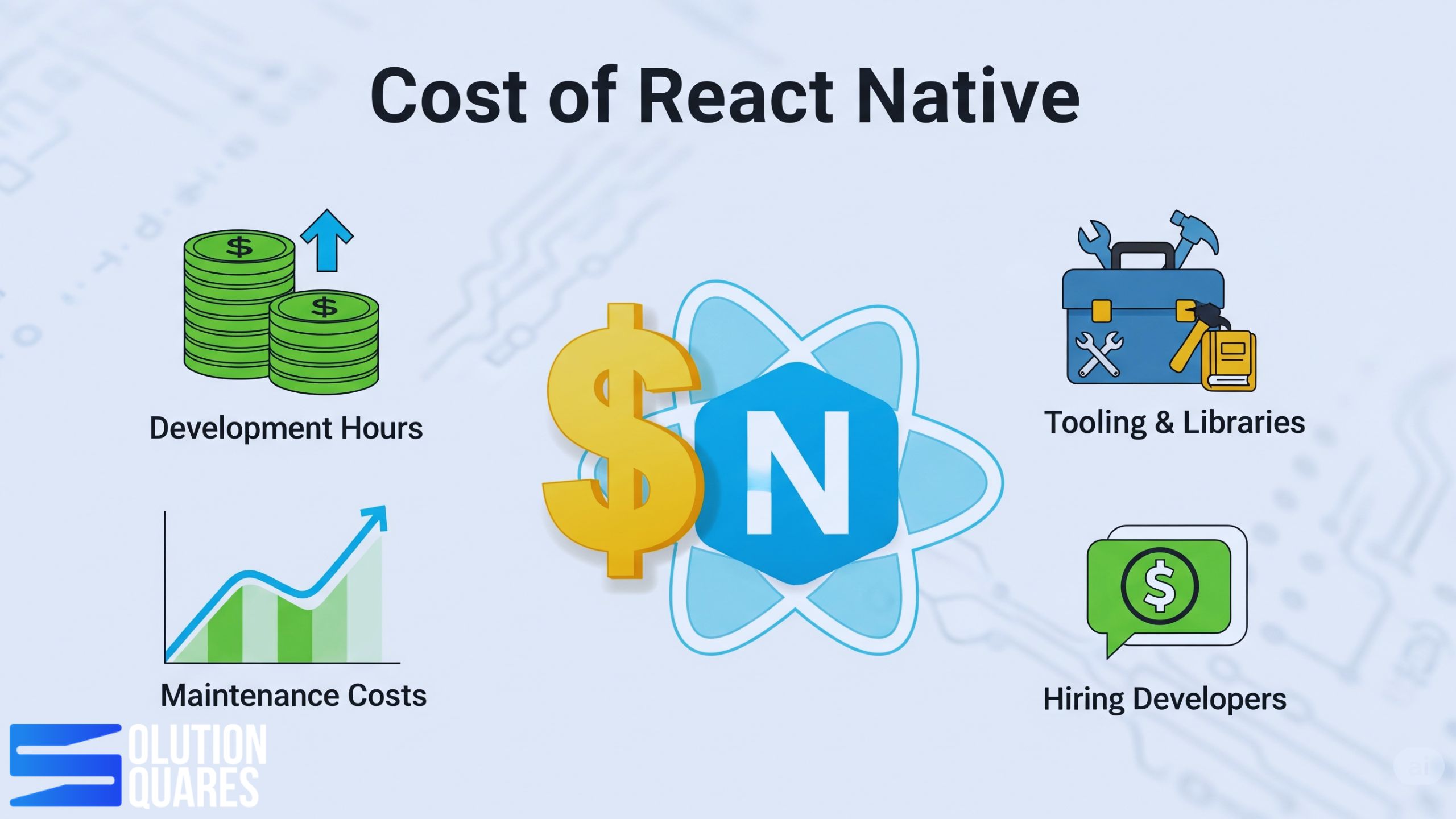
React Native development costs vary based on complexity, design requirements, and team location.
Choosing the right pricing model, such as hourly rates or fixed pricing, can significantly impact your budget.
The geographical location of the development team affects hourly rates and overall costs.
Optimising features and employing efficient project management can help manage and reduce costs.
Maintenance and additional services are crucial for the long-term success and scalability of your app.
Understanding the React Native App Cost for Mobile Development
When venturing into the world of mobile app development, one crucial aspect that often takes precedence in planning and decision-making is the cost involved. React Native app needs careful consideration to ensure the development process aligns with budget expectations and project goals.
In this comprehensive guide, we will delve into what influences the cost to build a React Native app, compare it with other development frameworks, and provide actionable insights on how to optimise your budget effectively.
Why Budgeting Is Essential in App Development?
Effective budgeting is pivotal in avoiding overruns and ensuring your project remains on track. Here, we will cover several factors like cost drivers, pricing models, and comparisons with other frameworks, which will aid in making informed decisions. For a deeper understanding of the overall cost of developing a mobile app, refer to Decoding the Cost of Developing a Mobile App: Crucial Factors, Hidden Expenses & Expert Insights.
Why Choose React Native for Cost-Efficient App Development?
Single Codebase for iOS & Android – Reduces time and cost of development.
Faster Time-to-Market – Shared components speed up development.
Large Community Support – Easier to find skilled developers and ready-made libraries.
Scalable & Flexible – Ideal for startups, SMEs, and enterprises alike.
What Influences the Cost to Build a React Native App?
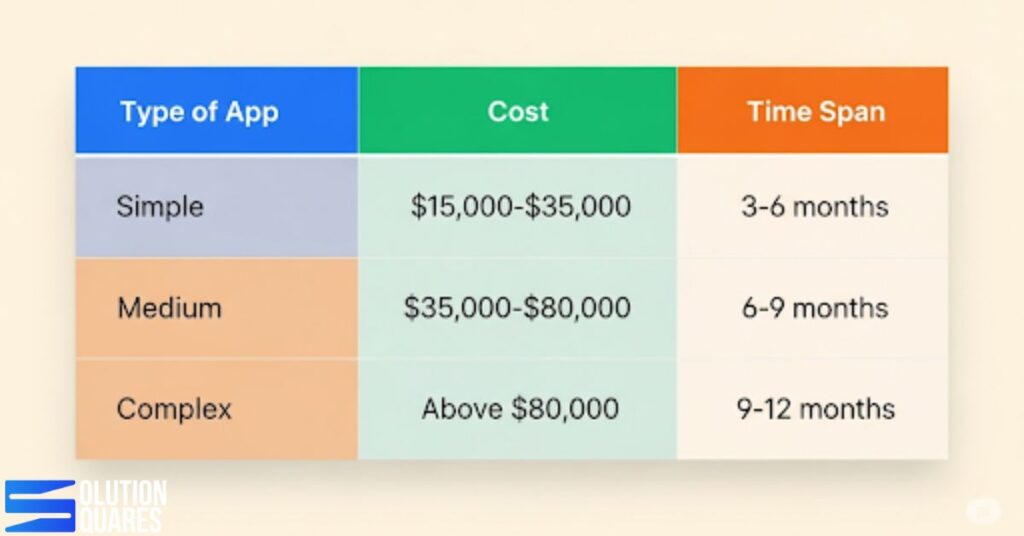
Generally cost of react native can be estimated with the type of project and the estimated time of work. Here in this table, you will get a rough estimation.
The cost of building a React Native application depends on multiple factors, ranging from the complexity of the app to the level of customisation required. Below are the key elements that influence overall pricing.
1. App Complexity
The complexity of features plays the most important role in determining cost. A simple app with static pages, basic login, and profile management will cost much less compared to a complex application that includes real-time tracking, chat systems, or AR/VR integration.
App Type
Features Included
Approx. Development Hours
Cost Impact
Basic
Login, profile, static pages
250–400 hrs
Low
Medium
Payment gateway, maps, API integration
400–800 hrs
Medium
Complex
Real-time sync, IoT, AR/VR, advanced animations
800+ hrs
High
2. Design and User Experience (UI/UX)
A well-crafted UI/UX is critical for user retention, but it adds to the development cost. If the app uses pre-designed templates, the cost is lower. However, if the client demands custom animations, branding-specific themes, and interactive elements, the pricing will rise.
3. Platform Choice
React Native allows building for both iOS and Android with a single codebase. However, if an app requires platform-specific native modules (like Face ID for iOS or custom Android integrations), additional effort is needed. This increases development time and cost.
4. Third-Party Integrations
Integrating features such as social media login, push notifications, chat systems, or analytics tools directly affects the price. The more integrations needed, the higher the complexity and budget.
5. Backend Development and APIs
Apps that require real-time data synchronization, cloud storage, or custom backend infrastructure will need additional development hours. For instance, building a simple app that connects with Firebase is cheaper compared to creating a custom backend with complex APIs.
6. Team Expertise and Location
The cost of hiring React Native developers varies across regions. Agencies in North America and Europe usually charge more per hour, whereas agencies in Asia and Eastern Europe are comparatively cost-effective. Highly experienced teams, though more expensive, can deliver scalable apps faster.
Region
Average Hourly Rate
North America
$80 – $150
Europe
$60 – $120
Asia/India
$25 – $50
7. App Maintenance and Updates
The launch of an app is not the end of the journey. Regular updates, bug fixes, and support for the latest OS versions require ongoing maintenance. This adds a recurring cost that agencies should always communicate to clients.
8. Testing and Quality Assurance
To ensure smooth performance, testing is mandatory. Simple apps may only require basic manual testing, while complex apps with multiple integrations need extensive automated testing. The more testing cycles, the higher the cost—but also the better the final product.
9. Deployment and App Store Publishing
Finally, the cost also includes preparing and submitting the app to the Apple App Store and Google Play Store. If frequent updates or compliance changes are needed, this will add to the long-term expense.
Understanding the React Native App Cost for Mobile Development
When venturing into the world of mobile app development, one crucial aspect that often takes precedence in planning and decision-making is the cost involved. Additionally, a React Native app needs careful consideration to ensure the development process aligns with budget expectations and project goals.
In this comprehensive guide, we will delve into what influences the cost to build a React Native app, compare it with other development frameworks, and provide actionable insights on how to optimise your budget effectively.
Why Budgeting Is Essential in App Development?
Effective budgeting is pivotal in avoiding overruns and ensuring your project remains on track. According to Netguru and Appinventiv, understanding the detailed expenditures involved can significantly affect the overall success of your app development project.
Why Choose React Native for Cost-Efficient App Development?
Single Codebase for iOS & Android – Reduces time and cost of development.
Faster Time-to-Market – Shared components speed up development.
Large Community Support – Easier to find skilled developers and ready-made libraries.
Scalable & Flexible – Ideal for startups, SMEs, and enterprises alike.
Which Factors Influence the Cost to Build a React Native App?
Development Complexity
Complexity in development is a major cost driver. Simple features like user authentication might cost less, while adding real-time chat or third-party integrations can significantly increase the budget.
The integration of third-party services alone can add between $3,000 $15,000 per feature. More details can be found on sources like Netguru, Kumohq, and Tekrevol.
Design Requirements
Choosing between a basic template and a custom-designed UI/UX also impacts the cost. Custom designs, requiring more expertise and time, tend to be more expensive. Moreover, specific cost implications of design choices are discussed further in references from Netguru and Tekrevol.
Development Team Location
The geographical location of your development team is crucial as it affects hourly rates. For instance, developers in North America might charge about $100–$150 per hour, whereas in Asia, the rates could be as low as $20–$50 per hour.
Rush projects can also spike the costs since they require more resources over a shorter period. Understanding the nuances of project timelines and their impact on costs can be further explored in sources like Netguru and Tekrevol.
Cost Optimisation Strategies for React Native Apps
Optimising the cost of a React Native app requires a strategic approach from the initial planning phase to the final deployment. By focusing on efficiency, reusability, and smart resource allocation, you can significantly reduce development expenses without compromising on quality.
Start with an MVP (Minimum Viable Product).
Launching a simple version of your app with only the core, essential features first allows you to get to market faster and at a lower cost. Further, this approach helps you validate your product idea and gather crucial user feedback early on. You can then use this feedback to prioritise future features, ensuring you only spend money on what your users truly need, avoiding wasted development effort.
Use Pre-Built UI Libraries and Components.
Building custom user interface (UI) components from scratch is time-consuming and expensive. Leveraging pre-built UI libraries like React Native Paper, NativeBase, or React Native Elements can save significant development time and resources. Indeed, these libraries provide a wide array of ready-to-use, customizable components that follow design guidelines, ensuring a consistent and professional look and feel for your app.
Leverage Open-Source Plugins and Packages.
For common functionalities such as push notifications, payment gateways, or authentication, avoid building solutions from the ground up. Moreover, the React Native ecosystem offers a vast repository of high-quality, open-source plugins and packages. By using these, your developers can quickly integrate a feature, rather than spending time on complex coding and debugging.
Adopt Agile Development Methodology.
An Agile approach, which involves breaking down the project into short, iterative cycles, offers greater flexibility and control over the development process. Further, this method allows for regular check-ins and feedback sessions, enabling you to make adjustments and re-prioritise tasks as needed. This iterative process helps in identifying and addressing potential issues early, preventing costly rework later in the project.
Outsource to Experienced Agencies.
Hiring an in-house team can be a significant financial commitment. Further, outsourcing your project to an experienced React Native development agency can be a more cost-effective solution. Agencies often have a well-defined process and a team of specialised developers, designers, and project managers, providing a high level of expertise at a predictable cost.
Prioritise Code Reusability
The core principle of React Native is code reusability across iOS and Android. To fully optimise costs, ensure your developers maximise this potential by writing modular, reusable code. This strategy not only reduces the amount of code needed but also simplifies maintenance and future updates.
Breakdown of React Native Development Pricing
Hourly Rates vs. Fixed Pricing
Choosing between hourly and fixed pricing models depends on your project’s clarity and scope. Hourly rates provide flexibility, while fixed pricing offers predictability. Moreover, each model’s pros and cons are critical to consider when budgeting.
Typical Pricing Structures
Simple Apps: Cost between $10,000 and $35,000, taking about 2–6 months to develop. More details can be found at Appinventiv and Tekrevol.
Medium Complexity Apps: Likely to cost between $35,000 and $80,000, with development times ranging from 4–9 months.
Complex Apps: These can range from $80,000 to over $300,000, needing 6–12+ months of development time.
Additional Costs
Budgeting for maintenance, updates, hosting, and backend services is crucial. Additionally, maintenance might require an additional 15–20% of the initial development cost annually. Hosting and backend expenses vary significantly based on complexity.
Cost to Build React Native App: Detailed Estimates
The costs of building a React Native app can broadly be classified into basic, intermediate, and advanced based on features and integrations. Moreover, estimated costs range from $10,000 for basic apps up to $300,000+ for highly advanced apps with extensive functionalities. More specific estimates are available at sources like Atharva System, Appinventiv, and Tekrevol.
Comparing React Native App Cost with Other Frameworks
The cost-effectiveness of React Native becomes apparent when compared to other development frameworks like Native Development or Flutter/Xamarin.
React Native tends to be 25–50% less costly and allows faster development cycles, benefiting significantly in terms of both cost and time due to its reusable components and single codebase approach. Moreover, comparisons can be explored in greater detail using resources from Kumohq and Appinventiv.
Optimising Your React Native Development Budget
Strategically choosing the features to implement, selecting the right development partner, and employing efficient project management methodologies like Agile can greatly optimise your budget. Prioritising a Minimum Viable Product (MVP) can also help keep initial costs down while allowing room for scalability. Further insights can be gathered from Tekrevol.
Discussing real-world case studies of projects varying in complexity helps illustrate potential cost scenarios and the importance of sound budget management to avoid overruns.
Hidden Costs to Consider
App Store & Play Store submission fees
Backend infrastructure and hosting (AWS, Firebase, or custom server)
Choosing between hourly and fixed pricing models depends on your project’s clarity and scope. Hourly rates provide flexibility, while fixed pricing offers predictability. Further, each model’s pros and cons are critical to consider when budgeting.
Typical Pricing Structures
Simple Apps: Cost between $10,000 and $35,000, taking about 2–6 months to develop. More details can be found at Appinventiv and Tekrevol.
Medium Complexity Apps: Likely to cost between $35,000 and $80,000, with development times ranging from 4–9 months.
Complex Apps: These can range from $80,000 to over $300,000, needing 6–12+ months of development time.
Additional Costs
Budgeting for maintenance, updates, hosting, and backend services is crucial. Maintenance might require an additional 15–20% of the initial development cost annually. Furthermore, hosting and backend expenses vary significantly based on complexity.
Cost to Build React Native App: Detailed Estimates
The costs of building a React Native app can broadly be classified into basic, intermediate, and advanced based on features and integrations. Estimated costs range from $10,000 for basic apps up to $300,000+ for highly advanced apps with extensive functionalities. More specific estimates are available at sources like Atharva System, Appinventiv, and Tekrevol.
Comparing React Native App Cost with Other Frameworks
The cost-effectiveness of React Native becomes apparent when compared to other development frameworks like Native Development or Flutter/Xamarin.
React Native tends to be 25–50% less costly and allows faster development cycles, benefiting significantly in terms of both cost and time due to its reusable components and single codebase approach. Comparisons can be explored in greater detail using resources from Kumohq and Appinventiv.
Optimising Your React Native Development Budget
Strategically choosing the features to implement, selecting the right development partner, and employing efficient project management methodologies like Agile can greatly optimise your budget. Additionally, prioritising a Minimum Viable Product (MVP) can also help keep initial costs down while allowing room for scalability. Further insights can be gathered from Tekrevol.
Discussing real-world case studies of projects varying in complexity helps illustrate potential cost scenarios and the importance of sound budget management to avoid overruns.
Hidden Costs to Consider
App Store & Play Store submission fees
Backend infrastructure and hosting (AWS, Firebase, or custom server)
In short, we have covered the critical aspects that determine the React Native app cost and how to efficiently plan and manage your budget. Investing in experienced development teams and thorough planning ensures you produce a scalable and high-quality mobile app. Moreover, we encourage you to reach out with your project specifics for a tailored cost estimate that meets your development needs.
Interested in getting an exact estimate for your React Native app or need consultation on your app development project? Contact us through our contact form or direct contact links provided here. We’re here to help you make your app development journey as smooth and cost-effective as possible.
Additional Resources
For more insights on budgeting and best practices in app development, visit our blog on React Native development pricing. Additionally, utilise tools like cost calculators and check out our planning guides to aid in your app development projects.
The cost can range from $5,000 for a simple app to over $300,000 for a highly complex app, depending on various factors like design complexity, features, and development platform.
If performance and access to device-specific features are critical, native development is preferable. If budget and development speed are priorities, hybrid development may be suitable.
Prioritizing features for an MVP, utilizing cross-platform development, and outsourcing to cost-effective regions are effective strategies to manage costs.
Regular updates enhance app performance and security.
Keeping React Native up-to-date minimises risks like compatibility issues.
Understanding the latest React Native versions is crucial for optimal performance.
Following a structured upgrade guide ensures a smooth transition.
Implementing best practices in maintenance boosts app reliability and longevity.
Comprehensive Guide to React Native Update: Best Practices for Upgrading Your React Native Version
Introduction
Updating a React Native app to a newer framework version is crucial to maintain its competitiveness and robustness in the fast-paced world of mobile applications. The process, known as a React Native update, involves not just enhancing the app with new features but ensuring it remains secure, efficient, and ahead of technology curves. This post dives deep into the best practices for upgrading your React Native version, focusing on the steps and strategies that facilitate efficient updates.
Upgrading your React Native app to the latest version is essential for performance improvements, bug fixes, and access to new features. However, the update process can be tricky if not handled carefully. This guide walks you through the importance of updating React Native, the challenges developers face, and the best practices for a seamless upgrade.
React Native, managed by Meta, is a prime choice for developers due to its cross-platform capabilities and vibrant ecosystem. These updates often bundle performance optimisations, critical security patches, and innovative features, making them indispensable for a top-performing app (source: Web and Crafts, Atomic Digital Labs).
Planning to upgrade your React Native app but worried about compatibility issues? Our experts can help you migrate seamlessly with zero downtime.
Why Updating React Native is Essential
Performing React Native maintenance through regular updates is integral to any development strategy. Here’s why keeping your React Native app updated is critical:
Performance Improvements: Updates can lead to faster iOS builds, decreased APK sizes, and enhanced rendering, which collectively boost app performance and user experience (source: Web and Crafts, Bacancy Technology).
Security Patches: These fix vulnerabilities, protecting user data and preserving the integrity of your business.
New Features and Tools: Each update may introduce new functionalities that allow for more stable and innovative app development (source: Atomic Digital Labs, React Native Blog 2025).
Risks of Neglecting Updates: Skipping updates can lead to severe issues like compatibility problems, use of deprecated APIs, and increased difficulty in future migrations (source: Web and Crafts, Atomic Digital Labs).
Understanding the Latest React Native Versions
React Native Update – What’s New?
React Native 0.81 (August 2025):
Added support for Android 16 and introduced experimental precompiled iOS builds for faster deployment.
Deprecated SafeAreaView, which necessitates adjustments in existing code (source: React Native Blog 2025).
React Native 0.80:
Integrated with React 19.1, introduced a strict TypeScript API, and reduced Android APK sizes significantly (source: Lucent Innovation, Bacancy Technology).
Step-by-Step Guide to Upgrading React Native Version
Preparation Before Upgrading
Before initiating an upgrade, it is essential to:
Backup Everything: Ensure you have a complete backup of your project’s code and dependencies.
Set Up a Test Environment: This helps in validating changes without affecting the production setup (source: Bacancy Technology). For detailed setup instructions, refer to our How to Build a React Native App.
Detailed Upgrade Steps
Consult Official Resources: Start with the React Native upgrade guide and the changelog for detailed instructions on the target version.
Update Dependencies: Modify package.json to include the latest versions of React, React Native, and Metro.
Address Breaking Changes: Make necessary code adjustments to align with new platform requirements (source: React Native Blog 2025). For strategies on handling breaking changes, check our React Native Testing Strategies.
Rebuild the App: Use package managers like npm or yarn to reinstall packages and rebuild your app for both iOS and Android platforms.
Establish a Maintenance Routine: Regular updates should be part of the maintenance schedule.
Utilise Update Automation Tools: Tools like Dependabot can help in keeping dependencies up to date. For more on maintaining your development environment, see Prerequisite React Native Development.
Monitor Application Health: Use tools like Sentry to detect and handle issues early.
Common Challenges When Upgrading React Native
When upgrading, developers often face challenges such as:
Breaking Changes and Deprecated APIs: It’s crucial to review the detailed release notes provided with each update (source: React Native Blog 2025).
Third-Party Compatibility Issues: Ensure all modules and plugins used in the app are compatible with the new version.
Native Dependencies – Issues with iOS and Android native modules can arise.
Time-Consuming Testing – Full regression testing is required to ensure app stability.
Case Studies and Success Stories
Discord: Improved load times significantly by reducing Time-to-Interactive on Android platforms through updates (source: Atomic Digital Labs).
Various Development Teams: Reported that incremental and well-planned updates align with community best practices and lead to smoother transitions (source: Web and Crafts, Atomic Digital Labs).
Future of React Native Updates
Future updates aim to enhance React Native by integrating it closely with React’s latest versions, focusing on modularity, improved TypeScript support, and better tooling (source: Lucent Innovation, Bacancy Technology, React Native Blog).
Additional Resources
For more detailed steps on upgrading React Native, check the React Native Upgrade Helper and stay updated with the React Native Changelog. Also, consider engaging with community channels like Reactiflux Discord and GitHub Discussions for support and tips.
Best Practices for React Native Updates
Use a Version Control System (Git) – Commit frequently to track changes.
Maintain a Testing Suite – Automate testing to catch bugs early.
Stay Aligned with Community Updates – Follow the React Native GitHub for release notes.
Use TypeScript – Helps catch issues early during migration.
Keep Dependencies Updated Regularly – Don’t wait too long between updates.
Conclusion
Regular React Native updates and consistent maintenance are vital to keeping your app reliable, secure, and in line with current technologies. By being proactive about upgrades, developers can reduce technical debt, future-proof their applications, and align with the best industry practices.
FAQ
1. How often should I update my React Native version?
It’s recommended to update React Native whenever a new stable version is released to take advantage of performance improvements, new features, and security patches.
2. What are the risks of not updating React Native regularly?
Neglecting updates can lead to compatibility issues, security vulnerabilities, deprecated API usage, and increased technical debt, making future updates more challenging.
3. How can I minimise downtime during the React Native upgrade process?
Setting up a test environment, thoroughly testing the new version before deployment, and following a step-by-step upgrade guide can help minimise downtime and ensure a smooth transition.
4. Are there tools that can assist with automating React Native updates?
Yes, tools like Dependabot can help automate dependency updates, and the React Native Upgrade Helper provides detailed guidance for each version upgrade.
5. What should I do if a third-party plugin is not compatible with the new React Native version?
Check if there’s an updated version of the plugin, look for alternative plugins, or consider contributing to the plugin’s repository to add compatibility with the new React Native version.
React Native enables cross-platform mobile app development with a unified JavaScript codebase.
Integration with native modules and third-party services enhances app functionality and user experience.
Utilising integrations can lead to significant cost savings and reduced development timelines.
The active React Native community provides continuous support and resources for developers.
In today’s digital world, users expect mobile apps to be seamless, fast, and feature-rich. React Native has emerged as a leading choice for cross-platform development, enabling businesses to build native-like apps for both iOS and Android using a single JavaScript codebase.
Its true power lies in integration—with third-party tools, APIs, and native modules—allowing developers to deliver advanced features, cost efficiency, and smooth user experiences. This makes React Native a go-to framework for building high-performing, future-ready mobile applications.
Why React Native?
React Native, developed by Meta, is a robust framework that allows agencies and businesses to build high-performance, cross-platform apps using a single codebase. This means your app can run smoothly on both iOS and Android, reducing development time and cost without compromising quality.
Key advantages include:
Faster Development – One codebase for multiple platforms.
Cost Efficiency – Lower expenses compared to building two separate native apps.
Scalability – Perfect for MVPs and large-scale applications alike.
Rich UI/UX – Native-like user experience with customizable design.
Future-Proof – Supported by a strong developer community and frequent updates.
Unlocking Business Potential with React Native Integration
For agencies and clients, React Native offers more than just speed and savings—it unlocks true business potential. By integrating React Native into your digital strategy, you can:
Reach a Wider Audience: Serve both Android and iOS users with one app.
Accelerate Time-to-Market: Launch faster and gain a competitive edge.
Simplify Maintenance: Updates and fixes are applied across platforms simultaneously.
Enable Growth-Ready Solutions: Add advanced features like AI, IoT, or real-time chat seamlessly.
At Solution Squares, we specialise in harnessing the power of React Native to build apps that aren’t just functional but also strategic business tools. Our approach focuses on aligning your app with your business goals—whether it’s customer engagement, revenue generation, or process optimisation.
Why Partner with Solution Squares?
Proven expertise in React Native app development.
A client-focused approach with tailored solutions.
End-to-end support from ideation to deployment.
Scalable and secure applications built for long-term growth.
Ready to Take the Next Step?
Your mobile app has the potential to transform your business—don’t let technology barriers slow you down. With React Native integration by Solution Squares, you get speed, efficiency, and quality under one roof. Get in touch today!
Understanding React Native Integration
React Native Integration involves integrating the React Native application with native device features, external APIs, or third-party libraries to expand its functionalities. Moreover, this form of integration serves as a bridge connecting the JavaScript-based framework with platform-specific components written in native languages such as Swift, Objective-C, Java, or Kotlin.
Types of Integration
React Native allows developers to connect mobile apps with a wide range of third-party services and APIs. This makes apps more powerful, user-friendly, and business-ready. Here are the most common integrations:
1. Payment Gateways
React Native apps can be integrated with secure payment solutions such as Stripe, PayPal, Razorpay, Braintree, or Square.
Stripe – Widely used for online payments and subscriptions.
PayPal – A trusted option for global transactions.
Razorpay – Popular in India, supporting UPI, wallets, and cards. These integrations allow users to pay directly within the app, making transactions fast and secure.
2. Social Logins
Adding login options via Google, Facebook, Apple, or LinkedIn improves user experience by reducing sign-up friction. Instead of creating new accounts, users can sign in instantly with their existing credentials.
3. Push Notifications
Push notifications keep users engaged by sending real-time updates, offers, or reminders. React Native integrates with services like Firebase Cloud Messaging (FCM), OneSignal, or Amazon SNS to deliver notifications across both Android and iOS.
4. Real-Time Chat and Video Calls
For apps that need communication features, React Native supports integrations with tools like Socket.IO, Twilio, or Agora. These allow businesses to add live chat, video conferencing, or voice calls directly into the application.
5. Maps and Geolocation Services
Apps with delivery, travel, or location-based services can integrate Google Maps, Apple Maps, or Mapbox. Features include real-time navigation, location tracking, geofencing, and custom route planning.
6. Analytics and Tracking Tools
React Native integrates with Google Analytics, Firebase Analytics, Mixpanel, or Amplitude to track user behaviour, measure engagement, and provide insights for business decisions. These tools help agencies and businesses improve app performance and ROI.
In short, React Native integration makes it possible to build apps that are not only feature-rich but also tailored to your business goals—whether it’s secure payments, smooth onboarding, customer engagement, or data-driven growth.
Importance of Integrations in React Native
Indeed, with the integration of third-party libraries and native modules, developers can craft feature-rich, scalable mobile applications optimised for both major platforms, inclusive of functionalities such as push notifications, geographic positioning, and real-time data synchronisation.
Furthermore, the adoption of existing solutions through integration minimises development timelines and reduces the cost involved, significantly influencing the overall project budgets positively.
Third-Party Integrations in React Native
Third-party integrations enable rapid, effective incorporation of extensive features into React Native apps, leveraging external libraries and services that extend beyond basic functionalities. Examples of popular libraries and services are:
Firebase:
Firebase offers a comprehensive backend solution with real-time database capabilities, authentication systems, and cloud functions. Learn how to integrate with Firebase.
Redux:
Redux facilitates efficient state management for React Native applications, ensuring smooth data flow across components.
Axios:
Axios simplifies the execution of HTTP requests, making it easier to interact with web-based services and APIs.
Addressing Challenges and Setting Trends for Future Integrations
Like any technology, React Native comes with challenges—
performance tuning,
third-party plugin dependencies,
staying updated with frequent releases.
At Solution Squares, we see these as opportunities to innovate. We don’t just solve today’s problems—we prepare your app for tomorrow. From AI-driven personalisation to IoT integrations and next-gen user experiences (AR/VR, voice, gesture controls), we’re constantly aligning your mobile strategy with future trends. This ensures your app isn’t just relevant at launch, but remains a long-term business asset.
Conclusion
React Native Integration is a cornerstone in developing powerful mobile applications that are both cost-effective and robust. By harnessing the strengths of third-party integration and the dynamic React Native community, developers can significantly enhance app functionality and operational efficiency.
We encourage you to delve into the myriad of integration options available and to actively participate in the React Native community for enriched learning and solution-oriented collaboration.
Frequently Asked Questions
1. Why should my business choose React Native for app development?
React Native enables faster development, reduced cost, and cross-platform reach. With a single codebase, your app can run smoothly on both iOS and Android, ensuring a wider audience and consistent performance.
2. Is React Native suitable for complex applications?
Yes. React Native supports complex features such as real-time chat, IoT integration, AR/VR, and AI-powered tools through native modules and third-party libraries. It is scalable enough for both startups and enterprise-level solutions.
3. Can React Native apps match the performance of fully native apps?
For most use cases, yes. React Native apps deliver near-native performance. For very performance-heavy tasks, developers can integrate native code directly to maintain speed and a smooth user experience.
React Native integration is essential for enhancing app functionality.
SQLite is a robust storage solution for React Native.
Integrations can reduce development time and costs while improving user satisfaction.
Proper integration ensures scalable and reliable mobile apps.
Harnessing the Power of React Native Integration with SQLite for Superior Mobile Apps
In today’s fast-paced mobile application development world, React Native has emerged as a key player, admired for its ability to enable cross-platform mobile app development with near-native performance. This blog post dives deep into a critical aspect of React Native application development: React Native integration, particularly focusing on storage solutions such as React Native with SQLite.
When it comes to mobile app development, data storage and management play a crucial role in ensuring smooth performance, scalability, and user satisfaction. For React Native developers, integrating a reliable database is essential to handle both offline and online data efficiently. SQLite, a lightweight and open-source relational database, has become one of the most popular choices for mobile applications built with React Native.[””””””
React Native’s popularity continues to soar as developers seek efficient solutions for quick and scalable mobile app deployment across iOS and Android platforms.
Importance of Integrations
Integrations in React Native are vital for enhancing an app’s functionality and scaling up user satisfaction. React Native integration makes it possible to incorporate various external services, APIs, and databases into your apps, therefore boosting their capabilities significantly. This post specifically focuses on React Native with SQLite, a potent combination for handling structured data efficiently.
Outline of the Blog Post
In this post, we will explore why and how to integrate SQLite with React Native, examine different storage solutions available, and provide a comprehensive comparison to help you make the right choice for your app. Additionally, we will cover troubleshooting tips, offer insights from recent statistics, and present real-world case studies to showcase the effectiveness of these technologies.
Understanding React Native Integration
Definition of Integration in React Native
Firstly, let’s clarify what React Native integration implies. It involves connecting React Native with external systems, APIs, or libraries to expand and enhance app features. This could range from adding payment gateways, push notifications, to database integration, thus enabling a richer user experience and streamlined app performance. For a deeper understanding of React Native integrations, refer to Unleashing the Power of React Native Integration for Feature-Rich Mobile App Development.
Common Integration Scenarios
Developers commonly integrate several functionalities depending on the app’s requirements, such as payment gateways for financial transactions, push notifications for user engagement, or databases for data management. Integration extends React Native’s capabilities, making it an even more powerful tool for app developers.
Benefits of Effective Integrations
Integrations can significantly reduce development time, cut down costs, and improve user satisfaction by providing smoother, more functional, and responsive app experiences. According to Computer.org, effective integrations are a key component in delivering superior app performance.
Transition to Storage Solutions
Having understood the basics of React Native integration, let’s explore storage solutions, particularly focusing on SQLite, an excellent choice for structured data management. To explore more about the best databases for React Native, check out Choosing the Best Database for Your React Native App.
Overview of Storage Solutions for React Native
List of Popular Storage Options
There are several storage solutions available for React Native, including AsyncStorage, Realm, Firebase, and SQLite. However, SQLite often stands out for its robust data handling capabilities.
Comparison of Storage Options
Here’s a brief comparison highlighting the strengths and suitable use cases for each storage option:
AsyncStorage is simple, though ideal for small data such as tokens or user preferences.
Realm offers faster reads and writes and is excellent for complex relational data with offline capabilities.
SQLite supports full SQL capabilities, making it ideal for larger, structured data sets.
What is SQLite?
SQLite is a serverless, lightweight SQL database engine that integrates seamlessly into React Native, allowing for robust data management without the need for a separate server process. Unlike server-based databases, SQLite is embedded directly into the app, making it:
Fast and efficient – No need for external server calls for local data.
Reliable for offline use – Perfect for apps that need to function without internet connectivity.
Lightweight – Consumes minimal device resources.
Cross-platform compatible – Works seamlessly on iOS, Android, and beyond.
For agencies, this means building apps that remain functional, responsive, and dependable, even when users are offline.
Why SQLite Stands Out?
SQLite offers unparalleled robustness, performance, and reliability, making it a preferred choice for developers needing to manage structured data efficiently. For optimising SQLite performance in React Native, refer to the Comprehensive Guide to React Native Performance Optimisation in 2025.
React Native with SQLite
Benefits of React Native + SQLite Integration
When React Native and SQLite work together, they create a robust foundation for modern mobile apps. Here are the key advantages:
1. Offline Functionality
Users don’t always have internet access. With SQLite, apps can store critical data locally, ensuring they work smoothly even offline. Data syncs automatically once the device is back online.
2. High Performance for Large Data
Apps handling large volumes of structured data (e.g., e-commerce, finance, healthcare) benefit from SQLite’s fast read/write operations. This leads to quicker load times and a better user experience. SQLite provides excellent performance and efficiency, particularly suitable for reading and writing operations within mobile applications. Reference the SQLite Performance Benchmark for detailed performance stats.
3. Data Security
SQLite supports data encryption to protect sensitive information. This is especially crucial for apps in industries like fintech, healthcare, and enterprise solutions.
4. Easy Integration with React Native
Developers can easily integrate SQLite into React Native apps using libraries like react-native-sqlite-storage. This enables complex queries, reliable storage, and seamless performance across platforms.
5. Cost-Effectiveness for Agencies
By leveraging SQLite with React Native, agencies save costs on additional backend infrastructure for smaller apps while still ensuring top-notch performance.
6. Reliability and Data Integrity
Being ACID-compliant, SQLite ensures all transactions are processed reliably, maintaining high data integrity even in offline conditions. Additionally, its popularity among developers is reflected in the Stack Overflow Developer Survey, showcasing its widespread use and trust.
Key Use Cases of React Native + SQLite
Offline-first apps – news, notes, or task apps.
E-commerce applications – storing cart data, preferences, and caching.
Enterprise apps – local data storage for employees working in low-connectivity areas.
Why React Native + SQLite Integration Works so Well
Insight
Details
Performance Boost
Up to 6× faster and dramatically lower memory usage with op-sqlite
Platform Consistency
iOS performance is uniform, Android benefits from batching and WAL modes
High Adoption
42% of developers reported using React Native development
Use Case Fit
Excellent for offline-capable, structured-data apps
Limitations
Not ideal for high-concurrency or large-scale, encrypted storage out of the box
Integration Steps
Here’s a step-by-step guide to integrating SQLite in your React Native app:
Install SQLite Package:
npm install react-native-sqlite-storage
Link the Native Module:
npx react-native link react-native-sqlite-storage
Initialisation and CRUD Operations Example: Here’s how you can initialise SQLite and perform basic CRUD operations:
javascript
import SQLite from 'react-native-sqlite-storage';
const db = SQLite.openDatabase({ name: 'myApp.db', location: 'default' });

db.transaction(tx => {
  tx.executeSql('CREATE TABLE IF NOT EXISTS users (id INTEGER PRIMARY KEY AUTOINCREMENT, name TEXT, age INT)');
  tx.executeSql('INSERT INTO users (name, age) VALUES ("Alice", 30)');
  tx.executeSql('SELECT * FROM users', [], (tx, results) => {
    console.log('Query completed');
    var len = results.rows.length;
    for (let i = 0; i < len; i++) {
      let row = results.rows.item(i);
      console.log(`ID: ${row.id}, Name: ${row.name}, Age: ${row.age}`);
    }
  });
});
Best Practices for Using SQLite in React Native
Use indexed queries for faster retrieval.
Regularly optimise and vacuum the database to improve performance.
Keep data models normalised for scalability.
Use SQLite for local + cache storage, but consider syncing with a cloud database (like Firebase or GraphQL backend) for hybrid solutions.
Secure sensitive data with encryption libraries like react-native-sqlcipher-storage.
Ensure your queries are optimised by indexing critical columns and using batch transactions to enhance performance.
Handle database schema changes carefully, using version control and migration strategies to manage updates without losing data.
Secure your data by implementing encryption techniques, especially when handling sensitive information to ensure data privacy and security. For detailed mobile app security practices, visit Mobile App Security Best Practices.
Statistical Insights
The adoption and satisfaction rates for SQLite within the React Native community are very high, reflecting its reliability and performance. Detailed surveys like the Stack Overflow Developer Survey reveal a significant preference for SQLite among developers for local data storage in mobile applications.
Case Studies and Real-World Applications
Several high-profile apps in the productivity, health, and finance sectors utilise React Native with SQLite effectively, enhancing their performance and data handling capabilities. For example, Unlocking Financial Freedom: The Surprising Truth About Fintech App Development Costs showcases how fintech applications benefit from robust data management solutions like SQLite.
Use Cases of React Native + SQLite
Agencies and businesses can rely on this combination to power apps across industries:
E-commerce Apps – Store product catalogues, shopping carts, and user data offline.
Healthcare Apps – Securely manage patient records and medical history.
Finance Apps – Handle sensitive transactions and offline account tracking.
Education Apps – Provide offline access to course materials and assessments.
Enterprise Solutions – Enable employees to work seamlessly even without internet connectivity.
Alternatives to SQLite
While SQLite is powerful, you may also consider:
Realm – for real-time syncing and larger datasets.
AsyncStorage – for lightweight key-value storage.
WatermelonDB – optimised for complex offline-first apps.
Troubleshooting Common Issues
Common issues such as installation or linking errors, data corruption, and performance bottlenecks can often be resolved by referring to the official documentation or community support forums.
Conclusion
In summary, React Native integration with SQLite offers a scalable, reliable solution for app development. Opting for SQLite can significantly enhance your app’s performance, especially when dealing with complex or large amounts of data. Ready to enhance your React Native app with SQLite? Start integrating today, and experience seamless performance and robust data management! Book Your Session
Frequently Asked Questions
What is React Native integration?
React Native integration involves extending the framework’s capabilities by connecting it with external systems or libraries.
Why should I use SQLite with React Native?
SQLite offers high performance, reliability, and the ability to handle complex, structured data efficiently.
How does SQLite compare to other storage solutions in React Native?
SQLite excels in scenarios where robust data management and offline capabilities are crucial, outperforming other options like AsyncStorage or Firebase in such use cases.
Can I use SQLite for large datasets in React Native apps?
Yes, SQLite is well-suited for managing large, relational datasets effectively.
What are the best practices for integrating SQLite with React Native?
Key practices include optimising queries, handling schema changes appropriately, and ensuring data security through encryption and other protective measures.
Community Support: Vital for problem-solving and innovation in React Native development.
Code Reusability: React Native allows for a single codebase across multiple platforms, enhancing efficiency.
Collaboration Benefits: Access to pre-built components and libraries accelerates development.
Continuous Innovation: The open-source nature fosters ongoing improvement and knowledge sharing.
Educational Resources: A wealth of tutorials and courses are available to enhance developer skills.
Introduction
The React Native community’s support plays a pivotal role in the development process, complementing the essential React Native documentation. For developers working with the React Native framework, the plethora of resources, forums, and discussions available can significantly streamline and enhance development efforts. This blog post delves into the importance of community involvement, shedding light on how it facilitates better problem-solving and innovation for mobile app development using React Native.
Understanding React Native
React Native is an innovative open-source framework initiated by Facebook. It enables developers to build mobile applications using JavaScript and React, offering the capability to deploy across multiple platforms such as iOS and Android from a single codebase. This framework not only simplifies the development process but also amplifies reach and efficiency.
Advantages of Using React Native
Code Reusability: Developers write code once and reuse it across multiple platforms, significantly reducing development time.
Cost-Efficiency: Utilising a smaller team without the need for platform-specific developers lowers the project costs.
Real-Time Updates: Features like fast refresh cycles facilitate quick iterations and bug fixes, enhancing the development workflow.
Performance and Maintenance: React Native delivers robust performance and simplifies maintenance, allowing for effective updates and streamlined testing across platforms.
The Role of Community Support in React Native
Problem-Solving and Knowledge Sharing
The active React Native community accelerates problem-solving by sharing experiences and code samples available on GitHub, backed by advice from seasoned experts. Whether a developer faces a specific programming challenge or needs general guidance, the community is a vital resource for solutions and enhancements.
Collaboration Benefits
With access to pre-built components and high-quality libraries shared within the community here, developers can ensure their application adheres to the best practices and security standards. Contributions from individuals and giants like Facebook enrich the React Native ecosystem, continually driving it forward.
Innovation and Knowledge Dissemination
The open-source nature of React Native supports ongoing improvement and innovation. The community actively participates in knowledge sharing through various platforms, which propels both personal growth and the advancement of the framework.
Key Sources of React Native Community Support
Official React Native Documentation
The primary go-to resource for developers, the official documentation (React Native Docs), offers comprehensive information on integration and platform-specific behaviours. Developers are encouraged to utilise the document’s search functions and explore detailed guides for best utilisation here.
Online Forums and Discussion Boards
Interactive platforms such as Stack Overflow and GitHub Discussions play a crucial role. Here, developers can pose questions, exchange ideas, and showcase their projects, obtaining feedback from a global network of peers.
Social Media and Online Communities
Social platforms like Reddit, Twitter, and Facebook groups offer lively spaces for real-time support and networking with fellow developers and experts.
Local Meetups and Conferences
Attending local meetups and international conferences provides invaluable opportunities for direct interaction, learning from seasoned experts, and sharing insights on a personal level.
Educational Resources and Tutorials
For those looking to expand their knowledge, numerous blogs, video tutorials, and online courses are available, ranging from beginner to advanced levels. These resources are curated by community members and established React Native contributors.
Maximising the Use of React Native Documentation
Combining official documentation with community insights allows developers to tackle complex challenges with enhanced context and support. It is also crucial to stay updated with the documentation to avoid common pitfalls, such as outdated methods or deprecated features.
Best Practices for Collaborating within the React Native Community
Engaging with the community through contributions to open-source projects, clear and respectful communication, and giving and receiving mentorship cultivates a healthy ecosystem. These practices not only aid personal growth but also contribute to the robustness of React Native.
Case Studies: Successful Problem-Solving through Community Support
Several real-world examples highlight how developers have overcome integration hurdles and enhanced functionalities through community collaboration. These insights are particularly valuable for illustrating practical applications of community support in resolving complex coding challenges.
One of the biggest strengths of the React Native ecosystem is its vibrant, global community. From open-source contributors to developers sharing insights on forums, the community has consistently helped businesses and agencies solve complex challenges faster and more efficiently.
Here are a few real-world examples of how community support has transformed projects:
Case Study 1: Optimising App Performance with SQLite
Challenge: An agency working on an e-commerce app faced issues with offline data management and slow query performance. Community Solution: By engaging with the React Native community, they discovered op-sqlite, a new high-performance SQLite library. With community benchmarks and guidance, the agency reduced query times by almost 5× and significantly improved offline reliability. Result: A seamless shopping experience, even in low-network areas, leading to higher user retention.
Case Study 2: Fixing Third-Party Library Conflicts
Challenge: A fintech app struggled with integrating multiple third-party libraries for payments and notifications, leading to crashes on Android. Community Solution: The development team leveraged community GitHub discussions and Stack Overflow threads where similar conflicts were documented. Solutions included using updated versions of the libraries and adopting autolinking best practices. Result: Stable cross-platform integration, faster deployment, and cost savings by avoiding unnecessary rebuilds.
Case Study 3: Leveraging Community Plugins for Faster MVP Launch
Challenge: A startup agency needed to deliver a client’s MVP in just 8 weeks with limited resources. Community Solution: Instead of building everything from scratch, they adopted open-source community plugins for authentication, maps, and push notifications. Supported by active contributors, these libraries were reliable and customizable. Result: The MVP was delivered on time, with robust features, giving the client a competitive edge in their market.
Key Takeaways for Agencies
The React Native community provides ready-made solutions for common challenges.
Engaging with forums, GitHub, and open-source contributors can save weeks of development time.
Community-driven tools often evolve faster than official releases, offering cutting-edge integrations.
At Solution Squares, we actively leverage community-driven insights to solve problems smarter and faster for our clients. By combining our expertise with the strength of the React Native ecosystem, we ensure apps are built with efficiency, reliability, and innovation.
Need expert guidance beyond community forums? Our React Native specialists are here to support you every step of the way.” Connect with Our Experts Today
Conclusion
The synergy between React Native community support and clear, up-to-date documentation forms the backbone of effective development within this ecosystem. By engaging with both these resources, developers can expect a well-rounded approach to building sophisticated and high-performing mobile applications. We encourage you to dive into the vibrant React Native community to leverage these benefits fully.
For local engagement opportunities, check Meetup.com for upcoming events and sessions.
The collective wisdom and resources of the React Native community are invaluable. Dive in, contribute, and harness the full potential of this dynamic framework!
Frequently Asked Questions
1. How much does it typically cost to develop a mobile app?
The cost can range from $5,000 for a simple app to over $300,000 for a highly complex app, depending on various factors like design complexity, features, and development platform.
2. How long does it take to develop a mobile app?
The development timeline can vary from a few months to over a year, depending on the app’s complexity and the development process.
3. Should I choose native or hybrid app development?
If performance and access to device-specific features are critical, native development is preferable. If budget and development speed are priorities, hybrid development may be suitable.
4. What are some cost-saving strategies for app development?
Prioritising features for an MVP, utilising cross-platform development, and outsourcing to cost-effective regions are effective strategies to manage costs.
5. Why is ongoing maintenance important for my app?
Regular maintenance ensures your app remains competitive, secure, and compatible with the latest devices and operating systems.
React Native agencies offer cross-platform efficiency, enabling a single codebase for both iOS and Android.
Specialised expertise ensures the development of scalable and high-performance mobile applications.
Adoption by major brands like Facebook and Instagram underscores React Native’s reliability.
Cost-effective solutions can reduce mobile app development costs by up to 40%.
Benefits include faster time-to-market and enhanced scalability.
Why Your Business Needs a React Native Agency for Mobile App Success
Introduction
A React Native agency specialises in creating high-performance mobile applications that streamline your digital strategy across multiple platforms. React Native agencies offer a specialised service that focuses on developing cost-effective, efficient, and scalable mobile apps using the React Native framework. For businesses considering an expansion into mobile apps, understanding the benefits of hiring a React Native agency could be the deciding factor for your success. In today’s digital landscape, where speed and performance are paramount, embracing the expertise of a dedicated React Native agency can significantly enhance your mobile presence. Discover how partnering with a React Native agency can transform your mobile strategy.
In today’s fast-paced digital landscape, businesses are under pressure to deliver high-quality mobile applications across both iOS and Android platforms—without breaking the bank or delaying time-to-market. While React Native offers a powerful solution with cross-platform development, the real challenge lies in implementation, optimisation, and scaling.
That’s where a React Native Agency comes in. Partnering with an experienced agency ensures your business leverages React Native to its fullest, avoiding pitfalls and accelerating growth.
What is a React Native Agency?
A React Native Agency is a specialised software development company focused on:
Building cross-platform apps with React Native.
Offering expertise in UI/UX design, development, testing, and deployment.
Providing ongoing support, performance optimisation, and scalability solutions.
Unlike freelancers or in-house teams with limited experience, agencies bring diverse skills, structured workflows, and proven strategies.
How To Include React Native Agencies In Your App Development?
In today’s competitive digital world, building a mobile app that is scalable, fast, and user-friendly requires not just the right technology but also the right expertise. Many businesses choose React Native agencies to accelerate development, reduce costs, and ensure quality delivery. But how exactly can you include a React Native agency in your app development journey?
1. Define Your Business Goals Clearly
Before partnering with an agency, outline what you want your app to achieve:
Do you need faster time-to-market?
Are you targeting both iOS and Android?
Do you need integrations like payments, chat, or offline storage (SQLite)?
Clarity on objectives helps agencies design the right architecture and select tools that align with your goals.
2. Choose the Right React Native Agency
Not all agencies are the same. Look for:
Proven case studies in your industry
Experience with React Native integrations (APIs, third-party libraries, native modules)
Strong UI/UX design capabilities
Transparent communication and project management
3. Collaborate on a Development Roadmap
Agencies should work as strategic partners, not just coders. Together, create a roadmap that includes:
Milestones (MVP → Beta → Full Launch)
Core features and integrations
Testing and performance optimisation cycles
This ensures your app is delivered on time, with room for scalability.
4. Leverage the Agency’s Technical Expertise
Agencies bring specialised skills beyond just coding:
Optimising performance with SQLite for offline-first apps
Seamless API and third-party integrations
Knowledge of best practices for deployment and maintenance
This expertise prevents costly mistakes and ensures a smooth user experience.
5. Establish Long-Term Partnership
App development doesn’t end at launch. Agencies can handle:
Maintenance and updates for new OS versions
Adding new features based on user feedback
Scaling the app as your business grows
A long-term partnership ensures your app stays relevant and competitive. Including a React Native agency in your app development journey is more than outsourcing—it’s about building a collaborative partnership that blends your business vision with technical expertise. The result? High-performing apps that meet user expectations and drive business growth.
Why Choose a React Native Agency?
Cross-Platform Efficiency
React Native allows developers to use a single codebase to deploy applications on both iOS and Android platforms. This unified development approach not only streamlines the process but also maintains consistency across different devices.
According to Le Backyard, this technique dramatically reduces development time and maintains feature parity across platforms, ensuring a seamless user experience regardless of the device. Furthermore, SolutionSquares supports this claim by providing additional insights.
One codebase runs on both iOS and Android—reducing development costs by up to 40-50% compared to native development. Agencies help maximise this advantage.
Faster Time-to-Market
Agencies use pre-built components, proven frameworks, and agile methodologies to deliver apps faster, helping businesses stay ahead of competitors.
Access to Expertise
Agencies provide specialised talent pools, including:
React Native developers
UI/UX designers
QA engineers
DevOps experts
Project managers
This all-in-one expertise ensures end-to-end delivery.
Scalability and Maintenance
A professional React Native agency ensures your app is built with future growth in mind. As your business expands, the agency can seamlessly scale your app to handle more users, new features, or integrations. They also provide ongoing maintenance and updates, so your app remains secure, functional, and aligned with the latest market standards.
Risk Reduction
Partnering with an experienced agency significantly lowers development risks. From the start, agencies anticipate potential challenges—like security loopholes, performance bottlenecks, or compatibility issues—and address them early. Whether it’s secure authentication, memory optimisation, or app speed improvements, agencies proactively solve problems before they affect your users. This saves both time and money while ensuring a smooth user experience.
Expertise & Specialization
Choosing a React Native agency gives you access to a team whose proficiency in the React Native framework ensures robust, scalable solutions tailored to meet specific business needs. Agencies bring a depth of knowledge that translates into high-quality mobile applications. For more insights, consider iTobuz, which highlights how these agencies employ professionals equipped with best practices expertise, fostering robust and scalable solutions. Additionally, SolutionSquares provides further validation.
Widespread Adoption
Major brands such as Facebook and Instagram are leveraging React Native for their mobile apps, showcasing the credibility and reliability of this technology. As noted by Studio Labs, the widespread adoption of React Native across such significant players supports its efficiency and scalability in handling diverse user demands.
Resource Savings
The streamlined development process associated with React Native allows for a 30-40% reduction in mobile app development costs, according to PagePro. This cost efficiency makes React Native an attractive option for businesses looking to optimise development budgets while achieving high-quality outcomes.
Given these substantial benefits, let’s delve into the key services offered by React Native agencies that help businesses maximise their mobile strategy.
Key Services Offered by React Native Agencies
A React Native agency provides end-to-end mobile app development solutions, helping businesses build high-quality, cross-platform applications that work seamlessly on both iOS and Android. Here are the core services you can expect:
1. React Native App Development
Building apps from scratch using a single JavaScript codebase.
Cross-platform deployment for iOS and Android.
Native-like performance with efficient UI/UX.
2. UI/UX Design
Wireframing and prototyping tailored to business goals.
Custom design systems with responsive layouts.
User-centric design ensures smooth navigation and engagement.
3. API & Third-Party Integrations
Payment gateways (Stripe, PayPal, Razorpay).
Social logins (Google, Facebook, Apple).
Maps, geolocation, analytics, and push notifications.
4. Database Integration & Management
SQLite, Firebase, Realm, and other database solutions.
Offline-first functionality for seamless user experience.
Scalable architecture for large datasets.
5. Migration & Upgrade Services
Migrating existing apps to React Native.
Upgrading older React Native versions to the latest stable release.
Ensuring compatibility with the latest iOS and Android platforms.
6. Performance Optimisation
Speed tuning for faster load times.
Reducing app size and memory usage.
Implementing best practices for stability and scalability.
7. Testing & Quality Assurance
Automated and manual testing.
Debugging and crash analytics.
Ensuring bug-free, high-performing apps before launch.
8. Deployment & Maintenance
Publishing apps to the App Store and Google Play.
Ongoing updates and feature enhancements.
24/7 maintenance and support.
9. Consulting & Strategy
Technical consulting for project planning.
Cost estimation and roadmap creation.
Recommendations for best tools, libraries, and integrations.
10. Custom Solutions for Agencies
White-label app development for agency partners.
Dedicated developer teams for long-term collaboration.
Flexible engagement models (fixed, hourly, or dedicated teams).
Benefits of Hiring a React Native Agency
Keywords: benefits of React Native agency, cost-effective mobile development, scalable mobile apps
Cost-Effectiveness
Using a shared codebase for iOS and Android app development not only streamlines the workflow but also cuts down costs significantly. Agencies utilising React Native can reduce the expenditure associated with app development by up to 40%, as reported by PagePro.
Faster Time-to-Market
The ability to develop quickly due to the unified codebase enables businesses to launch their products much faster. React Native agencies can deliver MVPs in a short timeframe, oftentimes within just six weeks, providing a competitive edge in the market. This benefit is outlined in detail at PagePro.
Scalability
As business needs grow, it’s crucial to have an app that can scale. React Native provides an excellent platform for developing apps that can easily be scaled up to meet increasing user demands or expanded business objectives. Insights into scalability are explored further at iTobuz.
To capitalise on these benefits, selecting the right React Native agency is essential for success. Let’s understand how to make the best choice for your business.
How to Choose the Right React Native Agency
Building a mobile app is a big investment, and the choice of a React Native agency can make or break your project. The right agency doesn’t just write code—it partners with you to deliver a product that is scalable, user-friendly, and aligned with your business goals. Here’s a guide to help you choose the right React Native agency for your app development journey. Choosing the right React Native agency involves several considerations to ensure that their service and expertise align with your business goals. Here are key factors to consider:
1. Check Their Experience & Portfolio
Look at the agency’s past projects:
Do they have experience in your industry?
Have they built apps with features like payment integrations, push notifications, or real-time chat?
Do their apps showcase strong UI/UX design and smooth performance?
A portfolio speaks louder than promises.
2. Evaluate Technical Expertise
The agency should be well-versed in:
React Native core framework
Database solutions like SQLite, Firebase, Realm
API and third-party integrations
Performance optimisation and debugging
Technical depth ensures your app is built to last.
3. Communication & Transparency
A successful project relies on smooth collaboration. Ensure the agency:
Provides clear timelines and cost breakdowns
Uses tools like Slack, Jira, or Trello for updates
Offers transparent progress reports and feedback loops
4. Consider Scalability & Support
Choose an agency that doesn’t stop at launch. They should:
Provide maintenance and regular updates
Scale the app as your business grows
Offer bug-fixing and support packages
5. Look for Client Testimonials & Reviews
Feedback from past clients can reveal:
How the agency handles challenges
Their problem-solving ability
Overall satisfaction with delivery and support
6. Compare Pricing Models
Cost is important, but value matters more. Agencies usually offer:
Fixed-price (best for small projects with a clear scope)
Hourly rates (flexibility for evolving projects)
Dedicated teams (ideal for long-term partnerships)
Choose a model that fits your project scope and budget.
7. Assess Cultural & Strategic Fit
Beyond skills, your agency should align with your vision. A good partner:
Understands your business goals
Suggests improvements, not just execution
Works as an extension of your team
Reviewing the work history and project outcomes of a potential agency gives insight into their capability and expertise. Look for diversity in their projects and relevance to your industry to ensure they can meet your specific needs.
Benefits of Hiring a React Native Agency Over In-House Teams
Factor
In-House Team
React Native Agency
Initial Cost
High (hiring, training)
Optimised (pay for expertise only)
Expertise
Limited
Diverse & specialized
Delivery Speed
Slower (learning curve)
Faster (proven workflows)
Scalability
Challenging
Easily scalable
Long-term Support
Needs extra hiring
Included in services
Case Studies and Success Stories
Real-life examples illustrate the effectiveness of React Native agencies in delivering successful projects. One notable case saw a 40% increase in user engagement after a business revamped its app with the assistance of a React Native agency, as documented in detail in the PagePro Case Study. Such statistics underscore the transformative potential of collaborating with specialised agencies.
With these insights and real-world examples, the value of hiring a React Native agency becomes evident. Moving to an understanding of typical pricing models will help in further shaping your decision.
Pricing Models and What to Expect
Overview of Pricing Structures
Fixed Price: Best suited for projects with a well-defined scope where deadlines and deliverables are clear.
Hourly Rate: Offers flexibility for projects that may evolve or require additional modifications.
Dedicated Teams: A dedicated team works exclusively on your project, providing consistency and depth in engagement.
Factors Influencing Pricing
The cost of hiring a React Native agency can vary significantly based on the complexity of the project, required features, integration with other systems, and ongoing support. Understanding these factors will help anticipate the budget needed for your mobile app development.
Collaboration Process
A typical engagement with a React Native agency involves several phases, including:
Initial Consultation: Understanding client needs and outlining the project scope.
Design and Prototyping: Creating visual and functional plans for the app.
Development: Building the app using React Native, based on agreed milestones.
Testing and Deployment: Ensuring the app is bug-free and ready for launch.
Ongoing Support: Providing maintenance and updates post-launch.
Understanding the pricing and collaboration process enables better planning and helps set realistic expectations for your mobile app project.
Statistical Insights on React Native Agencies
Keywords: React Native agency statistics, mobile development market growth, React Native performance metrics
Market Growth: The mobile development sector is seeing significant uptake of React Native due to its efficiency and cost-effectiveness, as detailed by PagePro.
Performance Metrics: React Native apps are known for up to 90% code reusability, providing near-native performance, which is a major advantage compared to other cross-platform frameworks. For more statistics, refer to Studio Labs.
Industry Adoption: React Native is being adopted across various industries, from tech giants to startups, aiding in faster development and better user engagement as seen in Amplework.
These metrics underline the robust capabilities of React Native and the strategic advantage of enlisting a specialised agency for your mobile development needs.
Conclusion
Partnering with a React Native agency positions your business at the forefront of mobile technology, offering benefits like cost-efficiency, expert knowledge, and enhanced scalability. The information provided reflects how these agencies facilitate better performance, quicker market entry, and long-term digital success. Ready to elevate your mobile presence? Contact a React Native agency today to discuss your app idea and start your digital transformation journey.
A React Native Agency is not just a development partner—it’s a strategic ally that helps businesses launch apps faster, cut costs, and scale efficiently. Whether you’re a startup looking for an MVP or an enterprise optimising for performance, partnering with the right agency ensures your app is future-ready, secure, and high-performing.
Frequently Asked Questions (FAQs)
What is a React Native agency?
Specialises in developing cross-platform mobile apps using React Native, providing both technical expertise and strategic deployment.
Why should I hire a React Native agency instead of in-house developers?
Offers specialised skillsets, quicker development cycles, and cost-effective solutions, freeing you from the burdens of an in-house setup.
How much does hiring a React Native agency cost?
Costs can vary based on project scope, features, and the chosen pricing model, but agencies offer flexibility to fit diverse budget ranges.
How long does it take to develop an app with a React Native agency?
Development time varies depending on app complexity, but agencies are known for rapid delivery, often deploying MVPs within six weeks.
What industries can benefit from React Native app development?
Industries such as finance, healthcare, e-commerce, and entertainment benefit from the cross-platform capabilities and scalability of React Native apps.