


Leveraging React Native with AI: Integrating Machine Learning into Your Mobile Apps
Key Takeaways
- React Native and AI Synergy: Combining React Native with Artificial Intelligence (AI) enhances mobile app functionality and user experience.
- AI-driven Features: Integration enables intelligent features such as image recognition, chatbots, and real-time predictions.
- Integration Methods: Various methodologies like prebuilt AI APIs, on-device machine learning, and native modules facilitate AI integration with React Native.
- Challenges: Integrating AI presents challenges, including performance issues and data privacy concerns.
- Best Practices: Adhering to best practices like code modularity and staying updated with AI advancements ensures efficient AI-powered app development.
Introduction: Embracing the Power of React Native with AI
In the rapidly evolving world of mobile app development, the integration of React Native with AI is catapulting developers into a new era of innovation. The synergy between React Native and Artificial Intelligence (AI) empowers developers to create more intelligent, responsive, and user-centric mobile applications with unprecedented ease. Recent trends show a significant surge in machine learning in React Native apps, transforming conventional mobile apps into smart mobile solutions across platforms.Artificial Intelligence (AI) has moved from being a buzzword to becoming a core feature of modern mobile applications. From chatbots and voice assistants to predictive analytics and image recognition, AI is transforming the way businesses interact with their customers.
For agencies building mobile apps with React Native, integrating AI can be the competitive advantage that sets your client’s product apart. In this article, we’ll explore why AI integration matters, how to implement it in React Native, and best practices agencies should follow.
This blog aims to guide you through the nuances of integrating AI with React Native, enabling you to enhance your app’s functionality exponentially. As AI/ML features like image recognition, chatbots, and real-time predictions become commonplace, leveraging accessible AI APIs and SDKs is more feasible than ever, even for those without deep ML expertise.
Understanding React Native
React Native, a pinnacle of cross-platform mobile app development, enables developers to deploy iOS and Android apps with a single JavaScript/TypeScript codebase. This framework not only boosts efficiency but also reduces development costs and time. The integration of React Native with AI adds a layer of intelligence to these apps, making them more interactive and engaging. Benefits of React Native:-
- Code reusability and faster deployment reduce time-to-market.
- Recent architectural upgrades, such as the Fabric and new layout engine, enhance performance and compatibility with native AI modules.
- An ever-expanding ecosystem, facilitating robust AI/ML integrations.
The Role of AI and Machine Learning in Mobile Apps
AI and Machine Learning (ML) redefine mobile app capabilities, introducing features that adapt and respond to user behaviour:- Enhanced Functionalities:
- Intelligent automation for routine tasks.
- Context awareness for personalised user experiences.
- Personalisation engines tailor content to user preferences, significantly boosting user engagement and app efficiency.
Why Integrate AI with React Native?
Leveraging AI with React Native elevates app functionality, enabling developers to craft exquisite, feature-rich applications across different platforms efficiently.- Advantages of AI Integration:
- Streamlines development processes, allowing for the rapid creation of complex features.
- Enhances user experience with features like real-time language translations, smart recommendations, and more efficient data handling, courtesy of localised AI computations, which diminish server dependencies.
Why Agencies Should Care About AI Integration
-
Enhanced User Experience → Smarter recommendations and personalised interfaces.
-
Cost Savings → Automated customer support through AI-driven chatbots.
-
Competitive Edge → AI-powered features help your client’s app stand out in the crowded market.
-
Scalability → AI enables apps to handle complex operations, from voice processing to predictive decision-making.
According to PwC research, AI could contribute $15.7 trillion to the global economy by 2030, with mobile apps playing a major role.
Methods for Integrating AI with React Native
Integrating AI into React Native apps can be accomplished through various methodologies tailored to specific needs and capabilities:- Using Prebuilt AI APIs and Services:
- Utilise platforms like Google Cloud AI, AWS AI, or OpenAI for quick integration of advanced AI features without extensive ML infrastructure.
- On-Device Machine Learning:
- Tools such as TensorFlow.js or ML Kit allow AI models to run directly on devices, safeguarding user privacy and ensuring functionality without internet access.
- Native Modules and Hybrid Approaches:
- For performance-intensive tasks, native modules provide the necessary horsepower, ensuring that your apps remain swift and responsive.
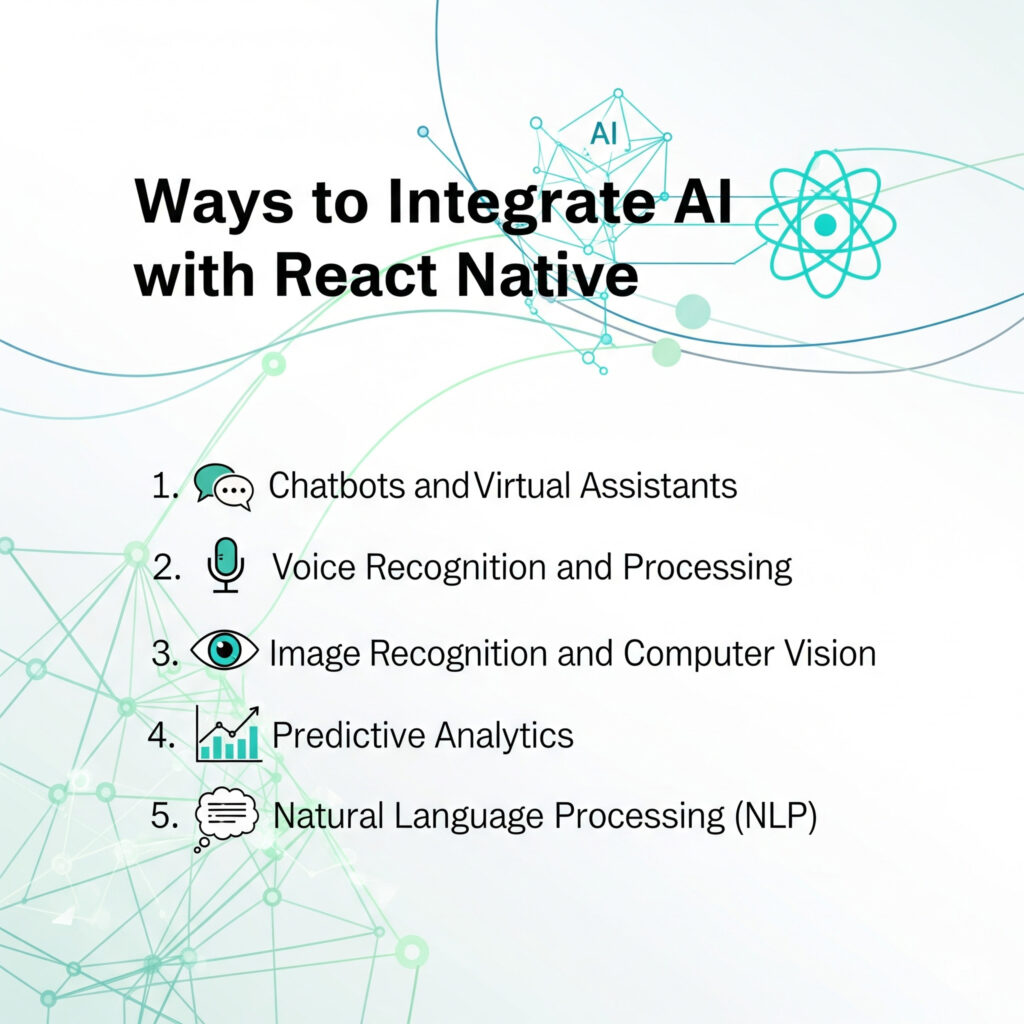
Ways to Integrate AI with React Native
1. Chatbots and Virtual Assistants
-
Integrate with Dialogflow, Rasa, or OpenAI APIs to enable conversational experiences.
-
Use React Native UI components for seamless in-app chat interfaces.
2. Voice Recognition and Processing
-
Use Google Speech-to-Text API or Amazon Transcribe.
-
Build voice-enabled features like voice search or smart commands.
3. Image Recognition and Computer Vision
-
Connect with Google Vision API, AWS Rekognition, or TensorFlow Lite.
-
Use cases: product scanning, face detection, AR experiences.
4. Predictive Analytics
-
Integrate with Azure Cognitive Services or Amazon SageMaker.
-
Provide data-driven insights, customer behaviour predictions, or recommendation engines.
5. Natural Language Processing (NLP)
-
Tools like spaCy, OpenAI GPT APIs, and Hugging Face Transformers help with sentiment analysis, text summarisation, and contextual search.
Common Challenges Agencies Face
-
Data Privacy & Compliance → Ensure GDPR and HIPAA standards where needed.
-
Performance Issues → AI tasks can be resource-heavy; cloud-based APIs help.
-
Integration Complexity → Requires skilled expertise in both React Native and AI frameworks.
Best Practices for Agencies
- Use cloud-based AI APIs for faster development.
- Ensure secure data handling with encryption.
- Implement caching and offline fallback where possible.
- Continuously monitor model performance and update as needed.
Technical Steps for Agencies
-
Select an AI Service Provider (Google, AWS, Azure, or custom-trained models).
-
Create API Keys for authentication.
-
Install Dependencies in React Native (
axios,react-native-voice, or@tensorflow/tfjs). -
Build Middleware for secure communication with AI APIs.
-
Optimise for Performance – Offload heavy processing to cloud services.
-
Test Across Platforms – Ensure AI features run smoothly on both iOS and Android.
Tools and Libraries for AI in React Native Apps
Choosing the right tools is crucial for successfully implementing AI features in your React Native apps:- TensorFlow.js: Allows you to use pre-trained models or train new models directly in JavaScript.
- ML Kit by Google: Offers ready-to-use APIs for text recognition, face detection, and more.
- React-native-ai: (Vercel AI SDK, MLC) facilitates running large language models locally on mobile devices. Callstack.
Step-by-Step Guide: Building a Machine Learning Feature in React Native
Implementing a machine learning feature within a React Native app involves several key steps:- Environment Setup:
- Start by setting up your development environment, choosing between React Native CLI and Expo based on your project requirements.
- Model Integration:
- Integrate ML models using JavaScript libraries or native modules, depending on the complexity and performance needs of your app.
- Optimisation and Testing:
- Optimise the feature for both platforms (iOS and Android), focusing on UI responsiveness and minimising errors during execution.
Challenges of Integrating AI with React Native
Despite its advantages, integrating AI with React Native presents certain challenges:- Performance Issues:
- Handling large models and ensuring swift inference times can be problematic on less capable devices.
- Data Privacy:
- Securing user data, especially when processing occurs on-device, is crucial for compliance with privacy laws.

Best Practices for Developing AI-Powered React Native Apps
To maximise the efficiency and scalability of your AI-powered apps, adhere to these best practices:- Code Modularity:
- Keep your AI features modular, separating them from the core application logic to simplify updates and maintenance.
- Stay Informed:
- Regularly update your knowledge base regarding new AI advancements and updates to existing libraries and frameworks.