


Key Takeaways
- Comprehensive Strategies: Implementing unit, integration, and end-to-end testing ensures robust React Native applications.
- Tool Selection: Utilising tools like Jest, React Native Testing Library, Detox, and Appium enhances testing efficiency.
- Quality Assurance: Integrating QA practices goes beyond testing to ensure performance and user experience.
- Best Practices: Maintaining tests and setting up a proper testing environment are crucial for ongoing app quality.
- Continuous Improvement: Adopting systematic testing strategies reduces bugs and increases user satisfaction.
Introduction
For agencies building mobile applications, delivering apps that are bug-free, stable, and reliable is just as important as delivering them on time. In 2025, clients expect more than just functioning apps—they expect high-quality digital experiences that work seamlessly across both iOS and Android.
That’s where a strong testing strategy for React Native projects comes in. By implementing the right mix of testing approaches, agencies can reduce costly production bugs, improve client satisfaction, and scale development efficiently.
Testing is a pivotal phase in the development of mobile apps, critical for ensuring that applications are robust, user-friendly, and reliable. In-depth testing strategies help minimise production bugs, thus significantly enhancing user satisfaction and trust in the application. This is particularly true when testing React Native apps, where quality assurance plays a central role in an app’s success.
Why Testing Matters for Agencies
You wouldn’t hand over the keys without ensuring the foundation is solid, the plumbing works, and the roof doesn’t leak. Mobile apps are no different. Clients expect perfection, and with good reason.
-
Protects Brand Reputation: Poorly tested apps lead to crashes, bad reviews, and client dissatisfaction.
-
Saves Time & Cost: Fixing bugs in production can cost up to 10x more than fixing them during development.
-
Ensures Cross-Platform Consistency: Testing guarantees consistent behaviour on iOS and Android devices.
-
Boosts Client Confidence: Demonstrating a clear testing process reassures clients about project quality.
-
Client Trust & Retention: Delivering bug-free, stable apps builds deep trust, fostering long-term partnerships.
-
Reduced Rework & Costs: Catching issues early in the development cycle is vastly cheaper than fixing them post-launch. Testing prevents costly rework and reputational damage.
-
Enhanced User Experience (UX): A well-tested app ensures a smooth, intuitive, and enjoyable experience, leading to higher user engagement and retention.
-
Competitive Edge: Agencies known for delivering high-quality applications stand out in a crowded market.
-
Faster Release Cycles: Automated and efficient testing allows for quicker iterations and confident deployments.
Key React Native Testing Strategies
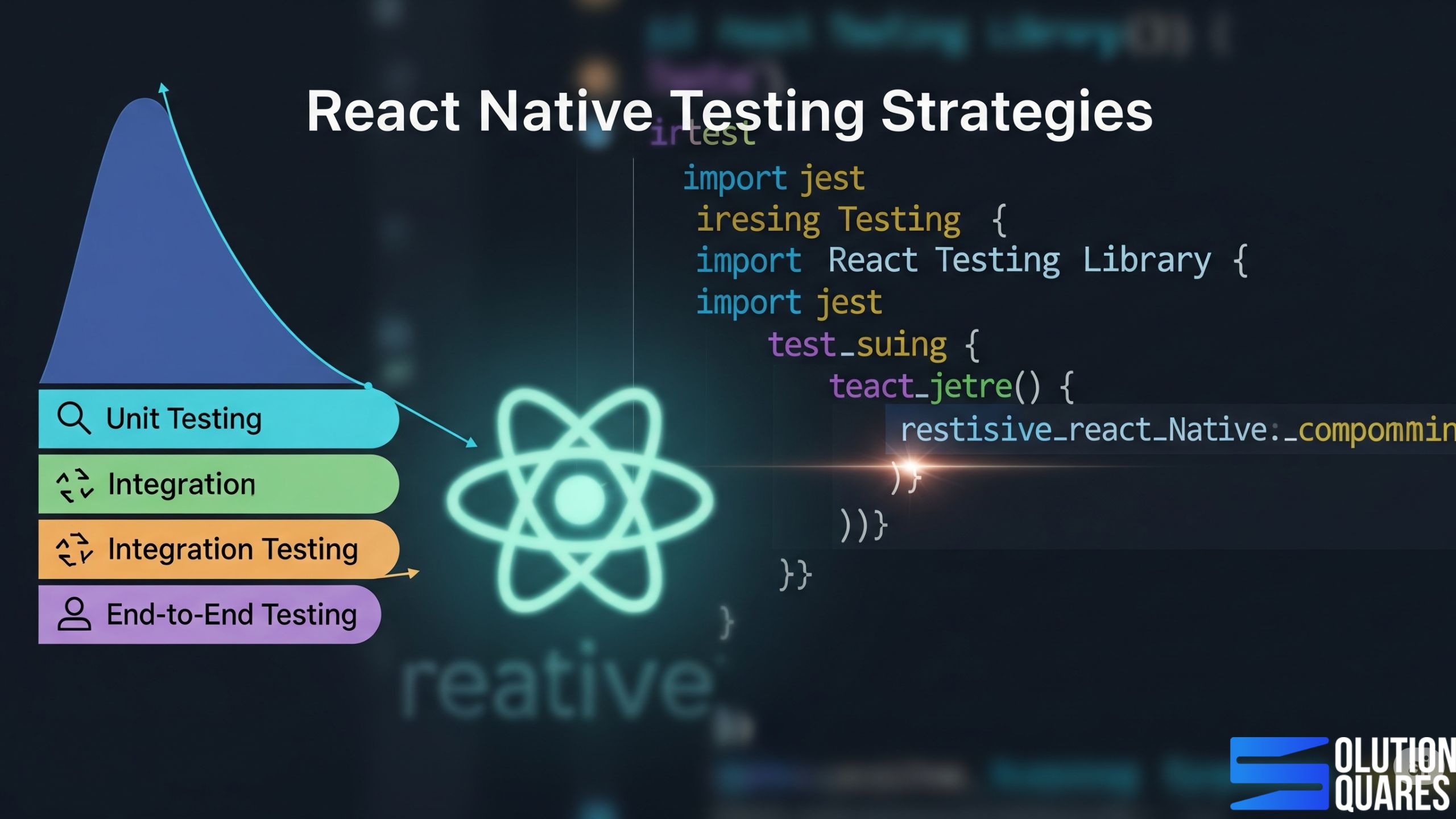
A comprehensive testing approach involves multiple layers, each designed to catch different types of bugs. We advocate for a “Test Pyramid” strategy, focusing on a broad base of fast, isolated tests, tapering up to fewer, more complex end-to-end tests.
1. Unit Testing: The Foundation of Reliability
Unit tests verify the smallest, isolated parts of your code – individual functions, pure components (components without side effects or complex logic), or utility methods. They ensure each “unit” works exactly as intended.
Why it’s important for agencies:
-
Early Bug Detection: Catches bugs right where they happen, preventing them from propagating.
-
Code Documentation: Acts as living documentation for how individual pieces of code should behave.
-
Faster Feedback: Unit tests run incredibly fast, providing immediate feedback to developers.
Essential Tools:
-
Jest: The go-to JavaScript testing framework, widely adopted in the React and React Native ecosystem. It’s fast, flexible, and provides powerful assertion capabilities.
2. Component Testing: Validating Your UI Blocks
Component tests focus on individual React Native components, ensuring they render correctly, respond to props, and handle user interactions as expected, often in isolation from the full application.
Why it’s important for agencies:
-
UI Stability: Ensures that your reusable UI components are robust and consistent, no matter where they’re used.
-
Isolation: Tests components without needing a full app environment, making them faster and more reliable than E2E tests for UI logic.
-
Designer-Developer Alignment: Verifies that components match design specifications.
Essential Tools:
-
React Native Testing Library (RNTL): Built on top of Jest, RNTL encourages testing components from the user’s perspective, focusing on what the user sees and interacts with, rather than internal implementation details.
3. Integration Testing: How Pieces Fit Together
Integration tests verify that different units or components interact correctly with each other. This could be two components communicating, a component interacting with a Redux store or a service layer integrating with an API mock.
Why it’s important for agencies:
-
Inter-Module Confidence: Ensures that when you combine tested units, their interactions don’t break.
-
Realistic Scenarios: Simulate more realistic application flows than isolated unit tests.
Essential Tools:
-
Often,
JestandReact Native Testing Librarycan be combined for integration tests by mounting multiple connected components or mocking API calls. For more complex scenarios, E2E tools can be adapted.

4. End-to-End (E2E) Testing: The Full User Journey
E2E tests simulate a full user journey through your application, interacting with the UI, navigating between screens, and verifying the entire flow from start to finish on a real device or emulator/simulator.
Why it’s important for agencies:
-
Comprehensive Validation: Catches bugs that might only appear when all parts of the app are working together.
-
User Confidence: Ensures critical user flows (e.g., login, checkout, data submission) are flawless.
-
Business Logic Validation: Verifies that the app’s core functionalities align with business requirements.
Essential Tools:
-
Detox: A popular and powerful E2E testing framework specifically designed for React Native. It runs tests on actual devices/simulators, synchronising with the app’s UI to avoid flakiness.
-
Appium: A versatile open-source test automation framework for native, hybrid, and mobile web apps. It supports iOS, Android, and Windows platforms, allowing the same test cases to run across multiple environments.
5. UI / Snapshot Testing: Guarding Against Visual Regressions
Snapshot tests capture the rendered output of a component (e.g., its JSX structure or a visual image) and save it as a “snapshot.” Future test runs compare the current output to the saved snapshot, alerting you to any unexpected UI changes.
Why it’s important for agencies:
-
Preventing Visual Bugs: Catches unintended UI changes, which can be critical for brand consistency and user experience.
-
Faster UI Review: Quickly identifies if a code change has suddenly altered the UI.
Essential Tools:
-
Jest Snapshot Testing: Integrated directly with Jest, making it easy to create and manage snapshots.
6. Performance Testing: The Need for Speed (and Smoothness)
Performance testing measures an app’s speed, responsiveness, stability, and resource usage under various loads. This includes startup time, frame rates, memory consumption, and network efficiency.
Why it’s important for agencies:
-
User Satisfaction & Retention: Slow apps drive users away. Performance testing ensures your apps are fast and fluid.
-
Resource Efficiency: Identifies memory leaks and CPU hogs, leading to better battery life and device compatibility.
-
Competitive Edge: Delivering highly performant apps is a key differentiator.
Essential Tools:
-
Flipper: Provides powerful performance tracking, including CPU and memory usage, network monitoring, and a layout viewer.
-
Native Profilers (Xcode Instruments for iOS, Android Studio Profiler for Android): For deep dives into platform-specific performance bottlenecks.
-
React Native Performance Monitor: A built-in React Native tool to track frame rates and UI performance.
-
Reassure: An open-source library that helps detect UI performance regressions at the component level.
7. Accessibility Testing: Inclusivity by Design
Accessibility testing ensures that your app is usable by people with disabilities, including those with visual, auditory, cognitive, or motor impairments. This involves proper semantic HTML (for web), screen reader labels, keyboard navigation, and adequate contrast ratios.
Why it’s important for agencies:
-
Broader Audience Reach: Ensures your clients’ apps are accessible to everyone, expanding their potential user base.
-
Legal Compliance: Meets accessibility standards (e.g., WCAG), reducing legal risks for clients.
-
Ethical Design: Demonstrates a commitment to inclusive design principles.
Essential Tools:
-
Native Accessibility Tools: iOS Accessibility Inspector, Android Accessibility Scanner.
-
Manual Testing: Crucial for understanding real user experiences with screen readers and other assistive technologies.
-
ESLint Plugins: Can enforce certain accessibility rules in code.
Benefits of Strong Testing Strategies for Agencies
-
Higher Client Retention: Clients trust agencies that deliver stable apps.
-
Reduced Risk: Minimise costly production bugs and app store rejections.
-
Scalable Growth: A repeatable testing framework means faster onboarding of new developers.
-
Upsell Opportunity: Offer Testing-as-a-Service to existing development clients.

Conclusion
In conclusion, a meticulous approach to React Native testing strategies is crucial for developing robust, efficient, and user-pleasing mobile applications. By integrating comprehensive testing protocols, from unit and integration testing to E2E scenarios, and aligning them with effective QA practices, teams can ensure that they deliver high-quality applications. Embracing these practices not only enhances the product quality but also optimises development workflows, ultimately leading to successful project outcomes and satisfied users. Final Thoughts
For further insights and detailed guides on React Native testing and QA, refer to the provided official documentation and additional resources.
Frequently Asked Questions
1. What are the best practices for React Native testing?
Best practices include writing comprehensive unit tests, integrating continuous testing in the CI/CD pipeline, using appropriate testing libraries, and maintaining clear and modular test cases.
2. How does integration testing differ from unit testing in React Native?
Unit testing focuses on individual components or functions to ensure they work correctly in isolation, whereas integration testing verifies that different parts of the application work together seamlessly.
3. Why is E2E testing important for mobile apps?
E2E testing ensures that the entire application flow works as intended from the user’s perspective, catching issues that might not be evident in isolated tests.
4. What tools are recommended for E2E testing in React Native?
Popular tools for E2E testing in React Native include Detox and Appium, which automate testing on real devices and emulators.
5. How can continuous integration improve React Native testing?
Continuous integration automates the testing process, ensuring that tests are run consistently with every code change, which helps in early detection of issues and maintains code quality.
