


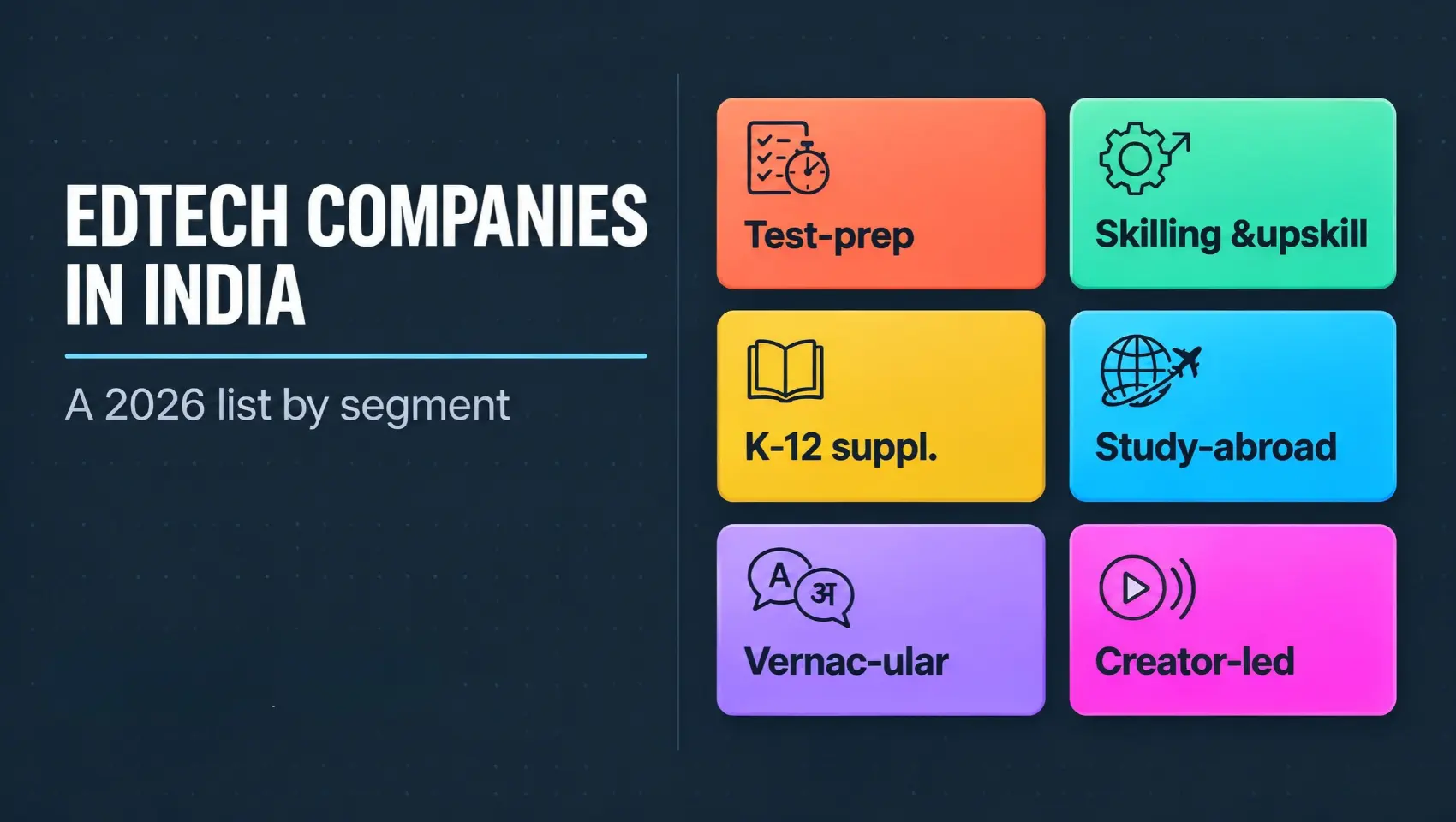
Edtech companies in India are businesses that sell online courses, test prep, and skilling programmes directly to learners through their own websites and mobile apps. This 2026 list groups the main players by segment test-prep, skilling, K-12 supplemental, study-abroad, vernacular and creator-led so you can see who operates where, and how each one runs the back office on an operating system for edtech companies.
This is a directory of examples, not a ranked top-N. Private valuations and user numbers are labelled “reported” and attributed to a named source, because self-reported figures move fast in this market.
How is India’s edtech industry segmented in 2026?
As of 2026, India’s edtech startups span six segments: test-prep, skilling, K-12 supplemental, study-abroad and English-test, vernacular, and creator-led course businesses. A segment view tells you more than a single leaderboard, because the companies differ enormously in who they sell to and how they deliver.
India’s edtech market was valued at about $7.5 billion in 2024 and is projected to reach $29 billion by 2030, according to an IAMAI and Grant Thornton report cited by Business Standard (17 January 2026). Funding, by contrast, has cooled: Inc42 reported that Indian edtech startups raised about $249 million in 2025, an eight-year low and roughly a 56% drop year-on-year (Inc42, 2026).
Which are the emerging edtech startups to watch in 2026?
Emerging edtech startups to watch in 2026 lean heavily toward vernacular and creator-led models. Named examples include Pariksha and Entri, both building regional-language exam and skilling content; GUVI, which teaches programming in Indian languages; and creator-first platforms Exly and Rigi, which help individual educators package and sell their own courses. Stimuler, a voice-first spoken-English tutor, is another newer entrant reported to be scaling in early 2026 (CB Insights company profile; YourStory Hindi, Hindi Diwas 2026 roundup).
These are early-stage or recently funded businesses rather than established leaders, so treat their scale claims as reported figures that will change.
Which test-prep companies lead in India?
India’s leading test-prep companies include Physics Wallah, Unacademy, Adda247, Testbook and Oliveboard, each running its own app and website for exams such as JEE, NEET, UPSC, banking and other government tests. This is the highest-fit segment for a dedicated operations platform, because enrolment, payments and mock tests all happen in-app.
Physics Wallah began as a JEE physics YouTube channel in 2016 and listed on Indian exchanges in November 2025 (Wikipedia; Reuters via Yahoo Finance, 18 November 2025). Adda247 publishes content in more than 12 Indian languages, reflecting how far test-prep has pushed into vernacular delivery (CB Insights company profile). Testbook and Oliveboard focus heavily on government-exam mock tests and current-affairs content delivered through their own apps.
What are the top skilling and upskilling platforms?
The top skilling and upskilling platforms in India include upGrad, Great Learning, Scaler, Simplilearn and Eruditus, all aimed at working adults building careers in tech, data, finance and management. These businesses sell cohort programmes, certificates and degrees direct to professionals, usually through a branded web-and-app experience.
upGrad is described as India’s largest professional-upskilling platform and completed its acquisition of Internshala in February 2026, extending its reach from internships into executive education (CB Insights; SourceForge upskilling comparison, 2026). Great Learning runs postgraduate and certificate programmes in analytics, AI, data science and cloud, with university partners including Stanford, MIT and IIT Madras (CXOToday). Eruditus is an executive-education player that has reached unicorn scale (Inc42, 2026).
Who are the main K-12 supplemental learning companies?
India’s main K-12 supplemental learning companies, distinct from school-administration software, include Vedantu, Doubtnut and Infinity Learn, which deliver after-school concept-building, doubt-solving and revision rather than running a school’s front office. The distinction matters: these apps sell to parents and students for home study, not to school admin teams managing admissions or timetables.
Vedantu runs live online tutoring for grades 6-12 and competitive-exam preparation (market profile; Money9 on its unicorn entry). Doubtnut lets students photograph a maths or science problem and get a video solution, and has said a large majority of its users come from outside India’s top 15 cities (TechCrunch; PitchBook company profile). Infinity Learn, backed by the Sri Chaitanya group, offers structured K-12 learning and test prep through its own app.
Which companies serve study-abroad and English-test prep?
Companies serving study-abroad and English-test prep in India include Leverage Edu, Yocket and Leap, which combine IELTS, GRE and GMAT preparation with university shortlisting, admissions, loans and visa support. They sell direct to students planning to study overseas, typically bundling test prep with counselling.
Leverage Edu lists preparation resources for IELTS, GMAT, GRE, SAT, TOEFL and PTE and operates across many Indian locations (CB Insights; Leverage Edu site, 2026). Yocket, founded in Mumbai in 2015, offers end-to-end support from GRE preparation through shortlisting to visa, forex and housing, and reports working with roughly 150 foreign institutions (YourStory, May 2022; CB Insights profile). Leap, founded in 2020 and based in Bangalore, pairs IELTS preparation with university guidance and financial planning (CB Insights company profile).
What about vernacular and creator-led course businesses?
Among the fastest-growing and most actively hiring edtech categories in India are vernacular course businesses — such as Entri, Adda247 and GUVI — and creator-led platforms including Classplus, Graphy, Exly and Rigi. Both groups distribute almost entirely through their own apps, which makes them a natural fit for a single operations platform.
Entri offers skilling and exam prep in Malayalam, Tamil, Telugu, Kannada and Hindi (The News Minute). GUVI teaches programming in regional languages and is now part of the HCL group (2026 skilling listicles). On the creator side, Classplus helps individual educators and small teams launch their own branded course apps, and raised $70 million in 2022 at a reported valuation of around $570 million (TechCrunch, March 2022). Graphy, Exly and Rigi give solo educators tools to publish courses, take payments and run a checkout under their own brand. This creator-led group is the clearest fit for Education Squares: individuals and small teams selling their own courses through their own website and app, with no IT department to build back-office systems from scratch.
What do these edtech companies have in common operationally?
Whatever the segment, these companies run the same five back-office jobs: capturing enquiries, collecting payments, managing student records, running assessments, and paying faculty. The brand, the subject and the exam change; the operational plumbing does not. That is why a segment-agnostic operating system makes sense for an edtech business selling through its own website and app.
In practice those five jobs map to five things that have to work every day:
- turn enquiries into enrolments without leads leaking between a form, a spreadsheet and a chat thread;
- collect fees reliably, and recover failed course payments that would otherwise be written off;
- run mock tests inside the app so practice and scoring sit next to the course, not in a separate tool;
- track faculty attendance and salary so teaching hours and payouts reconcile without a monthly scramble.
WellAcademy, an edtech business that sells courses through its own website and app, has used Education Squares every day since January 2026 to run exactly these jobs. One of those workflows, abandoned-cart recovery inside the payments module, produced a concrete, dated result:
WellAcademy’s abandoned-cart automation in Education Squares recovered ₹6,752.05 between 13 July and 13 August 2026 a single-month, mechanism-only figure, with no percentage or projection attached.
Segment economics are improving for the leaders, too: Physics Wallah reported net profit of about ₹69.7 crore for the quarter ended September 2025, up roughly 70% year-on-year (Storyboard18, 2025), a sign that disciplined operations, not just growth, now decide who survives.
Frequently asked questions
How many edtech companies are there in India?
India has hundreds of edtech companies spread across six segments test-prep, skilling, K-12 supplemental, study-abroad, vernacular and creator-led. There is no single authoritative count, because the total depends on how you define “edtech” and which startup trackers you use; Inc42’s 2026 rankings alone profile dozens of funded players across Bengaluru, Mumbai and Delhi NCR (Inc42, 2026). Treat any precise figure with caution.
What are the main types of edtech companies in India?
India’s edtech companies fall into six broad segments: test-prep platforms (JEE, NEET, UPSC, banking and government exams), skilling and upskilling platforms for working professionals, K-12 supplemental learning apps, study-abroad and English-test players, vernacular or regional-language businesses, and creator-led course businesses run by individual educators. Most sell directly to learners through their own website and mobile app rather than through a physical front desk.
Which is the biggest edtech company in India?
India’s largest edtech companies by reported scale include Physics Wallah, upGrad and Eruditus. Physics Wallah listed publicly in November 2025 and was valued at about $5.2 billion on its trading debut, after jumping roughly 49% (Reuters via Yahoo Finance, 18 November 2025). Rankings vary by whether you measure revenue, funding or valuation, so “biggest” depends on the metric; these figures are reported and change with each results cycle.
How many edtech unicorns does India have?
India has produced roughly half a dozen edtech unicorns, including Byju’s, Unacademy, upGrad, Eruditus, Vedantu and Physics Wallah (now a listed company). Inc42 reported Vedantu as the fifth Indian edtech startup to enter the unicorn club (Inc42, 2026). The exact live count shifts as valuations are re-rated and some companies list or restructure, so this is best read as a magnitude rather than a fixed number.
Which Indian cities have the most edtech companies?
Bangalore, Delhi NCR and Mumbai host the most edtech companies in India, with Bangalore the primary hub. Inc42 reported that Bengaluru-based edtech startups raised about $6.9 billion between 2014 and 2024, ahead of Mumbai ($2.6 billion) and Delhi NCR ($1.1 billion-plus) over the same period (Inc42, 2026). Delhi NCR’s leading names include Physics Wallah and Classplus.
What software do edtech companies use to run operations?
Edtech companies typically combine several tools a website and app for delivery, a payment gateway, a CRM for leads, a spreadsheet or HR tool for faculty, and a separate assessment product for tests. Education Squares brings those jobs into one system built for businesses that sell courses through their own website and app. It is deliberately more than an edtech CRM: CRM is one module alongside payments, student management, mock tests, and faculty attendance and salary, so enquiries, fees, learning and payroll stay in one place instead of scattered across separate tools.