

Key Takeaways
- React Native is a powerful framework for developing healthcare apps, offering cost-effectiveness and cross-platform capabilities.
- Utilising React Native can lead to faster development cycles, enhanced user experience, and improved scalability.
- Proper planning, design, and testing are crucial for successful healthcare app development with React Native.
- Data security, regulatory compliance, and interoperability are key challenges that React Native effectively addresses.
- Successful case studies demonstrate the effectiveness of React Native in patient management and telemedicine applications.
React Native for Healthcare Apps: Revolutionizing Mobile Healthcare Development
React Native for Healthcare Apps is a dynamic framework designed specifically for crafting vibrant mobile applications within the healthcare sector. As healthcare technology evolves, React Native has gained immense popularity for its robust capabilities and tailored approach to healthcare needs. This framework enables developers to create effective applications that cater to a variety of medical needs and operational efficiencies.
The healthcare industry is rapidly embracing digital transformation. Patients, doctors, and healthcare providers demand seamless mobile experiences for appointments, telemedicine, patient monitoring, and medical record access. React Native has emerged as a powerful solution for developing cross-platform healthcare apps that are fast, secure, and cost-effective.
Significance of Application Development in Healthcare
The development of applications in healthcare is transformative, revolutionizing the way medical practitioners and patients alike manage health-related activities. Key benefits include enhanced patient management processes, streamlined medical workflows, significant support for telemedicine, and improved accessibility to crucial data. Ultimately, these tools empower healthcare providers to offer superior care (Source). For a more in-depth understanding, refer to our Comprehensive Guide for Health App Development.
-
Fastest growth is in digital health overall (24.4% CAGR), signaling opportunities in AI-driven diagnostics, IoT-enabled healthcare, and telemedicine.
-
mHealth apps will see rapid adoption among patients, making them a crucial touchpoint for healthcare providers.
-
The services market shows steady but slower growth, indicating that infrastructure and service delivery will expand at a measured pace.
-
India is emerging as a major hub for digital health innovation, with strong potential for startups and tech-driven healthcare providers.
| Category | Key Data | Forecast / Growth |
|---|---|---|
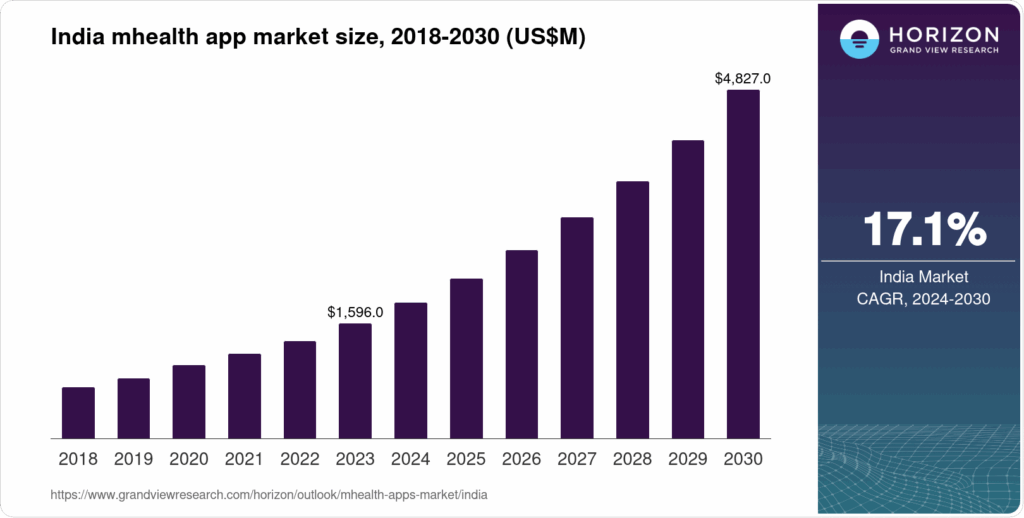
| India mHealth Apps Market | Revenue ~ USD 1,883.3 million in 2024 | Expected to reach ~ USD 4,827.0 million by 2030; CAGR ≈ 16.8% between 2025-2030. (Grand View Research) |
| India mHealth Market (All components) | ~ USD 2,498.1 million in 2023 | Expected to grow to ~ USD 6,944.1 million by 2030; CAGR ≈ 15.7% (Grand View Research) |
| India mHealth Services Market | ~ USD 1,003.6 million in 2023 | Projected ~ USD 2,447.8 million by 2030; CAGR ~ 13.6% (Grand View Research) |
| India Digital Health Market | Revenue ~ USD 14,330.2 million in 2024 | Forecasted to hit ~ USD 52,395.5 million by 2030; CAGR ~ 24.4% (Grand View Research) |
The Indian healthcare technology ecosystem is witnessing strong and sustained growth, driven by increasing smartphone penetration, demand for telemedicine, and government initiatives supporting digital health adoption.
-
mHealth Apps Market
-
Valued at USD 1.88 billion in 2024.
-
Expected to reach USD 4.83 billion by 2030, with a 16.8% CAGR.
-
This indicates rapid adoption of patient-facing apps for fitness, teleconsultation, and remote monitoring.
-
-
Overall mHealth Market
-
Worth USD 2.49 billion in 2023, projected to hit USD 6.94 billion by 2030.
-
CAGR of 15.7% highlights a balanced expansion across apps, services, and devices.
-
-
mHealth Services Market
-
Accounts for USD 1.0 billion in 2023, forecasted to more than double to USD 2.45 billion by 2030.
-
Growth rate of 13.6% shows steady demand for telemedicine platforms, diagnostic services, and digital therapy.
-
-
Digital Health Market
-
Much larger in scale, valued at USD 14.3 billion in 2024.
-
Projected to skyrocket to USD 52.4 billion by 2030, with a CAGR of 24.4%.
-
This shows that digital healthcare—including AI, IoT, wearables, and hospital IT systems—will be the biggest growth driver.
-
Why Choose React Native for Healthcare Apps?
React Native, initially conceptualised by Facebook, is a distinguished cross-platform development framework. It allows developers to use a unified codebase to build applications for both iOS and Android systems, making it a prime choice for healthcare applications where broad accessibility is crucial.
Utilizing React Native in healthcare applications offers numerous commercial benefits, such as lowering administrative costs, expanding market reach, and reducing development expenses. Informationally, it enriches medical data access, boosts patient engagement, and provides necessary real-time updates, thus enabling better patient care and service delivery (Source).
1. Cross-Platform Efficiency
React Native allows building apps for iOS and Android with a single codebase, ensuring faster development and reduced costs—ideal for healthcare providers looking to scale quickly (Source).
2. Secure and Compliant Development
Healthcare apps must adhere to strict compliance regulations such as HIPAA and GDPR. React Native supports integration with secure APIs, encryption standards, and data protection practices.
3. Real-Time Communication
Enable telemedicine, chatbots, and instant alerts through React Native’s support for WebSockets and third-party integrations
4. IoT & Wearable Device Integration
React Native apps can integrate with wearables and IoT devices to provide real-time monitoring of patient vitals, improving preventive care and remote healthcare.
5. Scalability & Performance
React Native’s architecture ensures smooth performance for large-scale healthcare platforms, from appointment booking apps to complex telehealth systems (Source).
6. Cost-effectiveness
The framework is not only adaptable but also economical. By facilitating a unified codebase, React Native slashes development and maintenance costs. Further, the availability of extensive open-source resources underlines the cost benefits, making premium healthcare app development accessible at reduced financial overhead (Source). Learn more about budgeting for React Native projects in our React Native App Cost Guide.
7. Speed of Deployment
The extensive component libraries available with React Native expedite the development of new features crucial for adapting to the ever-changing healthcare landscape. This rapid deployment capability allows healthcare organizations to remain agile and responsive to industry or regulatory changes (Source).
8. Faster Development Cycles & Reduced Time-to-Market
React Native dramatically reduces the development cycle thanks to its shared codebase and extensive pre-built libraries. This acceleration allows healthcare apps to be marketed quickly, providing timely solutions to emerging healthcare challenges (Source).
9. Reusability of Code
The reusability of code is a notable advantage when using React Native. Developing simultaneous applications for both iOS and Android from the same codebase not only streamlines the workflow but also speeds up subsequent updates, keeping all platform users on the same functional level (Source).
10. Enhanced User Experience and Performance
With the ability to customize UI components to fit specific needs, React Native enhances the user experience by offering native-like performance. This responsiveness is crucial for applications that handle sensitive medical information or support real-time patient-practitioner interactions (Source). Additionally, ensure your app adheres to the highest security standards by following our Mobile App Security Best Practices.
Key Use Cases of React Native in Healthcare
-
Telemedicine Platforms – Video consultations and online prescriptions.
-
Patient Portals – Access health records, schedule appointments, receive notifications.
-
Remote Monitoring Apps – Track vitals via IoT-enabled devices.
-
Pharmacy Apps – Online ordering, dosage reminders, digital prescriptions.
-
Healthcare Staff Apps – Shift management, patient tracking, secure
How to Create a React Native Healthcare App
Here is a step-by-step guide to developing a healthcare App with React Native.
Step-by-Step Guide on Creating a React Native Healthcare App
Planning and Defining App Requirements
Define the goals, target users, and regulatory needs upfront to ensure the app meets all necessary standards and serves its intended purpose effectively (Source).
Setting Up the Development Environment
Use the React Native CLI or Expo for initial setup, and configure the necessary tools, such as Android Studio and Xcode, for platform-specific requirements.
Designing User-friendly Interfaces
Employ React Native’s UI libraries to develop intuitive layouts that enhance accessibility and user engagement, tailored specifically for healthcare scenarios (Source).
Implementing Essential Healthcare Features
Integrate core functionalities like patient record management, appointment scheduling, and telemedicine. These features ensure the app addresses comprehensive health care processes and patient needs (Source). For more detailed feature implementation, refer to our guide on How to Develop the Best Hospital App.
Testing and Deployment Strategies
Execute rigorous testing to guarantee the app’s performance, security, and user accessibility standards. Effective deployment strategies uphold continuous improvement and adaptability.
Best Practices for Application Development in Healthcare
Maintaining high security, adhering to healthcare regulations, and collaborating with experts for compliance and data handling are paramount for securing user trust and regulatory approval (Source).
Tools and Resources for Healthcare App Development with React Native
Building a healthcare app requires more than just React Native—it needs the right set of tools, libraries, and resources to ensure security, compliance, scalability, and a great user experience. Below are some essential tools and resources:
1. Development & Framework Tools
-
React Native CLI / Expo – For rapid prototyping and cross-platform development.
-
TypeScript – Adds type safety and reduces bugs in complex healthcare apps.
-
Redux / Recoil – Efficient state management for handling real-time health data.
2. UI/UX Libraries
-
React Native Paper / NativeBase – Prebuilt UI components for healthcare dashboards.
-
React Native Elements – For patient-friendly design and intuitive interfaces.
-
Lottie for React Native – Smooth animations for patient engagement.
3. APIs & Integrations
-
FHIR (Fast Healthcare Interoperability Resources) APIs – For EHR/EMR integration.
-
Google Fit & Apple HealthKit – Access fitness and health data.
-
Twilio / Vonage – Secure telemedicine video calls and messaging.
4. Security & Compliance Tools
-
OAuth 2.0 & JWT – For secure authentication.
-
AWS Cognito / Firebase Auth – HIPAA-ready authentication management.
-
Datadog & Snyk – Security monitoring and vulnerability management.
5. Testing & Quality Assurance
-
Detox – End-to-end testing for React Native apps.
-
Jest & React Native Testing Library – Unit and UI testing.
-
Appium – Cross-platform automation testing.
6. DevOps & Deployment Tools
-
Fastlane – Automates app builds and deployments.
-
Microsoft App Centre – Continuous integration & delivery.
-
Bitrise / GitHub Actions – Streamlined CI/CD pipelines.
7. Learning Resources
-
React Native Official Docs – reactnative.dev
-
FHIR Standard Docs – hl7.org/fhir
-
HIPAA Compliance Guide for Developers – hipaa journal
-
SolutionSquares Blog – Best practices, tutorials, and case studies for healthcare app development.
Conclusion
React Native is a powerful framework for healthcare apps, offering scalability, cost-efficiency, and faster time-to-market. It ensures security and compliance while enabling innovation and better service delivery. With its speed, adaptability, and future-ready tools, React Native is the ultimate choice for building modern healthcare solutions. (Source).
Transform patient engagement with cross-platform healthcare apps—built with React Native! Book a Free Consultation Today.
Frequently Asked Questions
1. Why is React Native a good choice for healthcare apps?
React Native allows developers to build cross-platform apps (iOS and Android) with a single codebase, ensuring faster development, reduced costs, and consistent user experiences. Its scalability and native-like performance make it ideal for complex healthcare solutions.
2. How does React Native improve patient experience in healthcare apps?
It enables smooth navigation, real-time updates, telemedicine integrations, wearable device connectivity, and secure data handling—enhancing overall patient engagement and satisfaction.
3. Is React Native secure enough for healthcare apps?
Yes. React Native apps can be integrated with advanced security protocols such as HIPAA compliance, end-to-end encryption, multi-factor authentication, and secure data storage to ensure patient data privacy.
4. Can React Native apps integrate with wearable devices and IoT in healthcare?
Absolutely. React Native supports APIs and third-party libraries that allow integration with smartwatches, fitness trackers, and IoT medical devices for real-time monitoring and reporting.
5. What types of healthcare apps can be built with React Native?
-
Telemedicine and virtual consultation apps
-
Electronic Health Record (EHR) systems
-
Appointment booking and scheduling apps
-
Fitness and wellness trackers
-
Remote patient monitoring systems
-
Medicine delivery and pharmacy apps
6. How does React Native help healthcare providers reduce costs?
By using a single codebase for multiple platforms, healthcare organizations save on development, maintenance, and upgrade costs while still delivering high-quality, native-like apps.
7. Can React Native apps scale for large healthcare enterprises?
Yes. React Native is highly scalable and can support growing user bases, integration with hospital systems, and enterprise-level healthcare solutions.
8. How long does it take to develop a healthcare app with React Native?
The timeline varies based on features and complexity, but React Native typically reduces development time by 30–40% compared to building separate native apps.
9. How can React Native support telemedicine features?
React Native provides seamless integration for video conferencing APIs, chat systems, secure payment gateways, and cloud storage—key features in telemedicine apps.
10. What are some successful examples of healthcare apps built with React Native?
Popular healthcare and wellness apps like MedLife, Ada Health, and CareClinic leverage React Native for speed, scalability, and cross-platform performance.